1,4-Naphthoquinone
 | |
 | |
| Names | |
|---|---|
| Preferred IUPAC name
Naphthalene-1,4-dione | |
| Other names
1,4-Naphthoquinone
Naphthoquinone α-Naphthoquinone | |
| Identifiers | |
CAS Number
|
|
3D model (JSmol)
|
|
| ChEMBL | |
| ChemSpider | |
| ECHA InfoCard | 100.004.526 |
PubChem CID
|
|
| UNII | |
CompTox Dashboard (EPA)
|
|
InChI
| |
SMILES
| |
| Properties | |
Chemical formula
|
C10H6O2 |
| Molar mass | 158.15 g/mol |
| Density | 1.422 g/cm3 |
| Melting point | 126 °C (259 °F; 399 K) |
| Boiling point | Begins to sublime at 100 °C |
Solubility in water
|
0.09 g/L |
Magnetic susceptibility (χ)
|
−73.5·10−6 cm3/mol |
Except where otherwise noted, data are given for materials in their standard state (at 25 °C [77 °F], 100 kPa).
Infobox references
| |


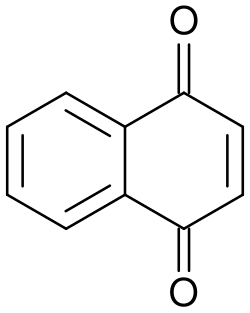
1,4-Naphthoquinone or para-naphthoquinone is a quinone derived from naphthalene. It forms volatile yellow triclinic crystals and has a sharp odor similar to benzoquinone. It is almost insoluble in cold water, slightly soluble in petroleum ether, and more soluble in polar organic solvents. In alkaline solutions it produces a reddish-brown color.
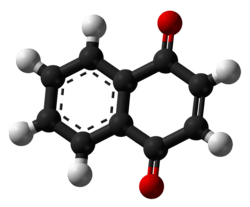
Natural vitamin K is a derivative of 1,4-naphthoquinone. It is a planar molecule with one aromatic ring fused to a quinone subunit.[2] 1,4-naphathoquinone itself has some vitamin K activity.[3]
It is an isomer of 1,2-naphthoquinone.
Preparation
The industrial synthesis involves aerobic oxidation of naphthalene over a vanadium oxide catalyst:[4]
- C10H8 + 3/2 O2 → C10H6O2 + H2O
In the laboratory, naphthoquinone can be produced by the oxidation of a variety of naphthalene compounds. An inexpensive route involves oxidation of naphthalene with chromium trioxide.[5]
Reactions
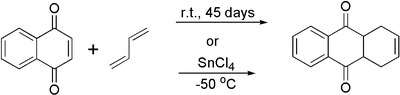
1,4-Naphthoquinone acts as strong dienophile in Diels-Alder reaction. Its adduct with 1,3-butadiene can be prepared by two methods: 1) long (45 days) exposure of naphthoquinone in neat liquid butadiene taken in huge excess at room temperature in a thick-wall glass tube or 2) fast catalyzed cycloaddition at low temperature in the presence of 1 equivalent of tin(IV) chloride:[6]
Reduction of 1,4-naphthoquinone with dithionite gives 1,4-dihydroxynaphthalene. The reaction is reversible: oxidation of the diol give back the quinone.[7]
Uses
1,4-Naphthoquinone is mainly used as a precursor to anthraquinone by reaction with butadiene followed by oxidation. Nitration gives 5-nitro-1,4-naphthalenedione, precursor to an aminoanthroquinone that is used as a dye precursor.[4]
Naphthoquinone functions as a ligand through its electrophilic carbon-carbon double bonds.[8]
Derivatives
Naphthoquinone forms the central chemical structure of many natural compounds, most notably the K vitamins. 2-Methyl-1,4-naphthoquinone, called menadione, is a more effective coagulant than vitamin K. Some naphthoquinone derivatives are cytotoxic, they have significant antibacterial, antifungal, antiviral, insecticidal, anti-inflammatory, and antipyretic properties. Plants with naphthoquinone content are widely used in China and the countries of South America, where they are used to treat malignant and parasitic diseases.[9]
Natural 1,4-naphthoquinones
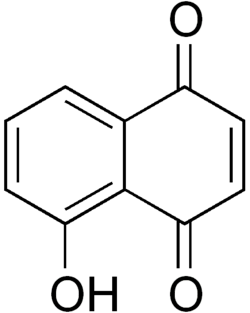
- Alkannin, commercial red-brown dye from Alkanna tinctoria
- Dichlone, a chlorinated derivative of 1,4-naphthoquinone, a fungicide.
- Droserone, found in plants of the genus Plumbago
- Hexahydroxy-1,4-naphthalenedione
- Juglone, growth-stunting exudate of black walnut trees
- Lapachol, yellow irritant from lapacho tree
- Lawsone, dye in henna
- Menatetrenone, a polyhydroxylated 1,4-naphthoquinone found in some sea urchins
- 2-Methoxy-1,4-naphthoquinone, a compound found in Impatiens species
- Nigrosporin B, lightly studied compound found in the fungus Nigrospora sp
- Plumbagin, yellow toxin found in plants of the genus Plumbago
- Spinochrome B, a marine pigment
- Spinochrome D, a marine pigment
- Vitamin K and related compounds
- Phylloquinone
- Vitamin K2
- Menadione (2-Methyl-1,4-naphthoquinone)
- Naphthazarin, red solid that occurs naturally and is earily prepared
Synthetic 1,4-naphthoquinones
- Atovaquone, a drug
- Buparvaquone, an antiprotozoal drug used in veterinary medicine
See also
- Hydroxynaphthoquinone
- 1,4-Benzoquinone
- Hooker reaction
References
- ^ Merck Index, 11th Edition, 6315.
- ^ Gaultier, J.; Hauw, C. (1965). "Structure de l'α-Naphtoquinone". Acta Crystallographica. 18 (2): 179–183. Bibcode:1965AcCry..18..179G. doi:10.1107/S0365110X65000439.
- ^ Fernholz, Erhard; Ansbacher, S.; MacPhillamy, H. B. (February 1940). "The Vitamin K Activity of Naphthoquinones". Journal of the American Chemical Society. 62 (2): 430–432. doi:10.1021/ja01859a052.
- ^ a b Grolig, J.; Wagner, R. "Naphthoquinones". Ullmann's Encyclopedia of Industrial Chemistry. Weinheim: Wiley-VCH. doi:10.1002/14356007.a17_067. ISBN 978-3-527-30673-2.
- ^ Braude, E. A.; Fawcett, J. S. (1953). "1,4-Naphthoquinone". Organic Syntheses. 33: 50. doi:10.15227/orgsyn.033.0050.
- ^ M.A. Filatov; S. Baluschev; I.Z. Ilieva; V. Enkelmann; T. Miteva; K. Landfester; S.E. Aleshchenkov; A.V. Cheprakov (2012). "Tetraaryltetraanthra[2,3]porphyrins: Synthesis, Structure, and Optical Properties". J. Org. Chem. 77 (24): 11119–11131. doi:10.1021/jo302135q. PMID 23205621.
- ^ Booth, Gerald (2000). "Naphthalene Derivatives". Ullmann's Encyclopedia of Industrial Chemistry. doi:10.1002/14356007.a17_009. ISBN 978-3-527-30385-4.
- ^ Kündig, E. P.; Lomberget, T.; Bragg, R.; Poulard, C.; Bernardinelli, G. (2004). "Desymmetrization of a meso-Diol Complex Derived from [Cr(CO)3(η6-5,8-Naphthoquinone)]: Use of New Diamine Acylation Catalysts". Chemical Communications. 2004 (13): 1548–1549. doi:10.1039/b404006f. PMID 15216374.
- ^ Babula, P.; Adam, V.; Havel, L.; Kizek, R. (2007). "Naphthoquinones and their Pharmacological Properties". Ceská a Slovenská Farmacie (in Czech). 56 (3): 114–120. PMID 17867522.
Types of phenolic compounds | |||||||||||||||||||||||||||||||||||||||||||||||||||||||||||||||||||||||||||||||||||
|---|---|---|---|---|---|---|---|---|---|---|---|---|---|---|---|---|---|---|---|---|---|---|---|---|---|---|---|---|---|---|---|---|---|---|---|---|---|---|---|---|---|---|---|---|---|---|---|---|---|---|---|---|---|---|---|---|---|---|---|---|---|---|---|---|---|---|---|---|---|---|---|---|---|---|---|---|---|---|---|---|---|---|---|
| Natural monophenols |
| ||||||||||||||||||||||||||||||||||||||||||||||||||||||||||||||||||||||||||||||||||
| Polyphenols |
| ||||||||||||||||||||||||||||||||||||||||||||||||||||||||||||||||||||||||||||||||||
| Aromatic acids |
| ||||||||||||||||||||||||||||||||||||||||||||||||||||||||||||||||||||||||||||||||||
| Phenylethanoids |
| ||||||||||||||||||||||||||||||||||||||||||||||||||||||||||||||||||||||||||||||||||
| Others | |||||||||||||||||||||||||||||||||||||||||||||||||||||||||||||||||||||||||||||||||||
| Misc: |
| ||||||||||||||||||||||||||||||||||||||||||||||||||||||||||||||||||||||||||||||||||
