Barium peroxide
 | |
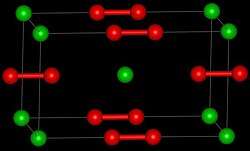 Barium cations Ba2+ Peroxide anions O2−2 | |
| Names | |
|---|---|
| IUPAC name
barium peroxide
| |
| Other names
Barium binoxide,
Barium dioxide | |
| Identifiers | |
CAS Number
|
|
3D model (JSmol)
|
|
| ChemSpider | |
| ECHA InfoCard | 100.013.754 |
| EC Number |
|
PubChem CID
|
|
| RTECS number |
|
| UNII | |
| UN number | 1449 |
CompTox Dashboard (EPA)
|
|
InChI
| |
SMILES
| |
| Properties | |
Chemical formula
|
BaO2 |
| Molar mass |
|
| Appearance | Grey-white crystalline solid (anhydrous) Colorless solid (octahydrate) |
| Odor | Odorless |
| Density |
|
| Melting point | 450 °C (842 °F; 723 K) |
| Boiling point | 800 °C (1,470 °F; 1,070 K) (decomposes to BaO & O2.[1]) |
Solubility in water
|
|
| Solubility | dissolves with decomposition in acid |
Magnetic susceptibility (χ)
|
−40.6×10⁻⁶ cm3/mol |
| Structure | |
Crystal structure
|
Tetragonal[2] |
Space group
|
D174h, I4/mmm, tI6 |
Coordination geometry
|
6 |
| Hazards | |
| GHS labelling: | |
Pictograms
|
 
|
Signal word
|
Warning |
Hazard statements
|
H272, H302, H332 |
Precautionary statements
|
P210, P220, P221, P261, P264, P270, P271, P280, P301+P312, P304+P312, P304+P340, P312, P330, P370+P378, P501 |
| NFPA 704 (fire diamond) | 
3
0
2 OX |
Except where otherwise noted, data are given for materials in their standard state (at 25 °C [77 °F], 100 kPa).
Infobox references
| |


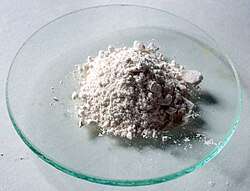
Barium peroxide is an inorganic compound with the formula BaO2. This white solid (gray when impure) is one of the most common inorganic peroxides, and it was the first peroxide compound discovered. Being an oxidizer and giving a vivid green colour upon ignition (as do all barium compounds), it finds some use in fireworks; historically, it was also used as a precursor for hydrogen peroxide.[3]
Structure
Barium peroxide consists of barium cations Ba2+ and peroxide anions O2−2. The solid is isomorphous to calcium carbide, CaC2.
Preparation and use
Barium peroxide arises by the reversible reaction of O2 with barium oxide. The peroxide forms around 500 °C (932 °F) and oxygen is released above 820 °C (1,510 °F).[1]
- 2 BaO + O2 ⇌ 2 BaO2
This reaction is the basis for the now-obsolete Brin process for separating oxygen from the atmosphere. Other oxides, e.g. Na2O and SrO, behave similarly.[4]
In another obsolete application, barium peroxide was once used to produce hydrogen peroxide via its reaction with sulfuric acid:[3]
- BaO2 + H2SO4 → H2O2 + BaSO4
The insoluble barium sulfate is filtered from the mixture.
Footnotes
- ^ a b Middleburgh, Simon C.; Lagerlof, Karl Peter D.; Grimes, Robin W. (January 2013). "Accommodation of Excess Oxygen in Group II Monoxides". Journal of the American Ceramic Society. 96 (1): 308–311. doi:10.1111/j.1551-2916.2012.05452.x.
- ^ Massalimov, I. A.; Kireeva, M. S.; Sangalov, Yu. A. (2002). "Structure and Properties of Mechanically Activated Barium Peroxide". Inorganic Materials. 38 (4): 363–366. doi:10.1023/A:1015105922260.
- ^ a b Harald Jakob; Stefan Leininger; Thomas Lehmann; Sylvia Jacobi; Sven Gutewort. "Peroxo Compounds, Inorganic". Ullmann's Encyclopedia of Industrial Chemistry. Weinheim: Wiley-VCH. doi:10.1002/14356007.a19_177.pub2. ISBN 978-3-527-30673-2.
- ^ Wiberg, Egon; Wiberg, Nils; Holleman, A. F. (2001). Inorganic chemistry (1st English ed.). San Diego : Berlin; New York: Academic Press; De Gruyter. ISBN 0-12-352651-5.