Dichlorofluoromethane
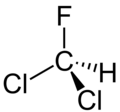 | |
| Names | |
|---|---|
| Preferred IUPAC name
Dichloro(fluoro)methane | |
| Other names
Dichlorofluoromethane
Fluorodichloromethane Monofluorodichloromethane Dichloromonofluoromethane Freon 21 Refrigerant 21 R 21 HCFC 21 Algofrene Type 5 Arcton 7 Halon 112 UN 1029 Genetron 21 | |
| Identifiers | |
CAS Number
|
|
3D model (JSmol)
|
|
| ChEMBL | |
| ChemSpider | |
| ECHA InfoCard | 100.000.791 |
| EC Number |
|
PubChem CID
|
|
| RTECS number |
|
| UNII | |
| UN number | 1029 |
CompTox Dashboard (EPA)
|
|
InChI
| |
SMILES
| |
| Properties | |
Chemical formula
|
CHCl2F |
| Molar mass | 102.92 g/mol |
| Appearance | Colorless gas |
| Odor | Ether-like[1] |
| Density |
|
| Melting point | −135 °C (−211 °F; 138 K) |
| Boiling point | 8.92 °C (48.06 °F; 282.07 K) |
Solubility in water
|
9.420 g/L at 30 °C |
| log P | 1.55 |
| Vapor pressure | 160 kPa |
Henry's law
constant (kH) |
0.19 (mol·kg·bar)−1 |
Magnetic susceptibility (χ)
|
−48.8·10−6 cm3/mol |
| Thermal conductivity | 0.0086 W/m·K (300 K)[2] |
| Hazards | |
| GHS labelling: | |
Pictograms
|

|
Signal word
|
Warning |
Hazard statements
|
H420 |
Precautionary statements
|
P410+P403, P502 |
| Flash point | Non-flammable[1] |
Autoignition
temperature |
522 °C (972 °F; 795 K) |
| Lethal dose or concentration (LD, LC): | |
LC50 (median concentration)
|
|
LCLo (lowest published)
|
|
| NIOSH (US health exposure limits): | |
PEL (Permissible)
|
TWA 1000 ppm (4200 mg/m3)[1] |
REL (Recommended)
|
TWA 10 ppm (40 mg/m3)[1] |
IDLH (Immediate danger)
|
5000 ppm[1] |
Except where otherwise noted, data are given for materials in their standard state (at 25 °C [77 °F], 100 kPa).
Infobox references
| |


Dichlorofluoromethane or Freon 21 or R 21 is a halomethane or hydrochlorofluorocarbon with the formula CHCl2F. It is a colorless and odorless gas. It is produced by fluorination of chloroform using a catalyst such as antimony trifluoride:[4]
- CHCl3 + HF → CHCl2F + HCl
Uses
Dichlorofluoromethane was used as a propellant and refrigerant. Due to its role in ozone depletion, dichlorofluoromethane has been largely phased out. It has ozone depletion potential 0.04. Production and consumption has been since 2004 reduced to 15% of level from 1989 and it is to be phased out in 2015 according to Montreal Protocol.
Pyrolysis of a mixture of dichlorofluoromethane and chlorofluoromethane gives hexafluorobenzene:[4]
- 3 CHCl2F + 3 CH2ClF → C6F6 + 9 HCl
Additional physical data
Its critical point is at 178.5 °C (451.7 K) and 5.17 MPa (51.7 bar). At temperatures from 5 K to 105 K, it has one phase in the space group Pbca.
Safety
Its toxicity is comparable to that of chloroform. Its TLV is 10 ppm.[4]
References
- ^ a b c d e NIOSH Pocket Guide to Chemical Hazards. "#0197". National Institute for Occupational Safety and Health (NIOSH).
- ^ Touloukian, Y.S., Liley, P.E., and Saxena, S.C. Thermophysical properties of matter - the TPRC data series. Volume 3. Thermal conductivity - nonmetallic liquids and gases. Data book. 1970.
- ^ a b "Dichloromonofluoromethane". Immediately Dangerous to Life or Health Concentrations. National Institute for Occupational Safety and Health.
- ^ a b c Dagani, M. J.; Barda, H. J.; Benya, T. J.; Sanders, D. C. "Bromine Compounds". Ullmann's Encyclopedia of Industrial Chemistry. Weinheim: Wiley-VCH. doi:10.1002/14356007.a04_405. ISBN 978-3-527-30673-2.
External links
- International Chemical Safety Card 1106
- NIOSH Pocket Guide to Chemical Hazards. "#0197". National Institute for Occupational Safety and Health (NIOSH).
- Termochemistry data at chemnet.ru
- Entry at Air Gas Liquide Encyclopaedia Archived 2021-02-18 at the Wayback Machine