Magnesium nitrate
 | |
 | |
| Names | |
|---|---|
| IUPAC name
Magnesium nitrate
| |
| Other names
Nitromagnesite (hexahydrate)
| |
| Identifiers | |
CAS Number
|
|
3D model (JSmol)
|
|
| ChEBI | |
| ChemSpider | |
| ECHA InfoCard | 100.030.739 |
| EC Number |
|
PubChem CID
|
|
| RTECS number |
|
| UNII |
|
| UN number | 1474 |
CompTox Dashboard (EPA)
|
|
InChI
| |
SMILES
| |
| Properties | |
Chemical formula
|
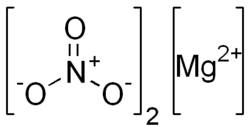
Mg(NO3)2 |
| Molar mass | 148.32 g/mol (anhydrous) 184.35 g/mol (dihydrate) 256.41 g/mol (hexahydr.) |
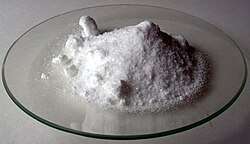
| Appearance | White crystalline solid |
| Density | 2.3 g/cm3 (anhydrous) 2.0256 g/cm3 (dihydrate) 1.464 g/cm3 (hexahydrate) |
| Melting point | 129 °C (264 °F; 402 K) (dihydrate) 88.9 °C (hexahydrate) |
| Boiling point | 330 °C (626 °F; 603 K) decomposes |
Solubility in water
|
71 g/100 mL (25 °C)[1] |
| Solubility | moderately soluble in ethanol, ammonia |
Refractive index (nD)
|
1.34 (hexahydrate) |
| Structure | |
Crystal structure
|
cubic |
| Thermochemistry | |
Heat capacity (C)
|
141.9 J/mol K |
Std molar
entropy (S⦵298) |
164 J/mol K |
Std enthalpy of
formation (ΔfH⦵298) |
−790.7 kJ/mol |
Gibbs free energy (ΔfG⦵)
|
−589.4 kJ/mol |
| Hazards | |
| Occupational safety and health (OHS/OSH): | |
Main hazards
|
Irritant |
| GHS labelling: | |
Pictograms
|
 
|
Signal word
|
Warning |
Hazard statements
|
H272, H315, H319, H335 |
Precautionary statements
|
P210, P220, P221, P261, P264, P271, P280, P302+P352, P304+P340, P305+P351+P338, P312, P321, P332+P313, P337+P313, P362, P370+P378, P403+P233, P405, P501 |
| NFPA 704 (fire diamond) | 
1
0
0 OX |
| Safety data sheet (SDS) | External MSDS |
| Related compounds | |
Other anions
|
Magnesium sulfate Magnesium chloride |
Other cations
|
Beryllium nitrate Calcium nitrate Strontium nitrate Barium nitrate |
Except where otherwise noted, data are given for materials in their standard state (at 25 °C [77 °F], 100 kPa).
Infobox references
| |


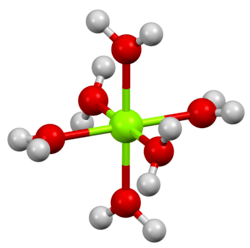
Magnesium nitrate refers to inorganic compounds with the formula Mg(NO3)2(H2O)x, where x = 6, 2, and 0. All are white solids.[2] The anhydrous material is hygroscopic, quickly forming the hexahydrate upon standing in air. All of the salts are very soluble in both water and ethanol.
Occurrence, preparation, structure
Being highly water-soluble, magnesium nitrate occurs naturally only in mines and caverns as nitromagnesite (hexahydrate form).[3]
The magnesium nitrate used in commerce is made by the reaction of nitric acid and various magnesium salts.
Use
The principal use is as a dehydrating agent in the preparation of concentrated nitric acid.[2]
Its fertilizer grade has 10.5% nitrogen and 9.4% magnesium, so it is listed as 10.5-0-0 + 9.4% Mg. Fertilizer blends containing magnesium nitrate also have ammonium nitrate, calcium nitrate, potassium nitrate and micronutrients in most cases; these blends are used in the greenhouse and hydroponics trade.
Reactions
Magnesium nitrate reacts with alkali metal hydroxide to form the corresponding nitrate:
- Mg(NO3)2 + 2 NaOH → Mg(OH)2 + 2 NaNO3.
Since magnesium nitrate has a high affinity for water, heating the hexahydrate does not result in the dehydration of the salt, but rather its decomposition into magnesium oxide, oxygen, and nitrogen oxides:
- 2 Mg(NO3)2 → 2 MgO + 4 NO2 + O2.
The absorption of these nitrogen oxides in water is one possible route to synthesize nitric acid. Although inefficient, this method does not require the use of any strong acid.
It is also occasionally used as a desiccant.
References
- ^ Lide, David R., ed. (2006). CRC Handbook of Chemistry and Physics (87th ed.). Boca Raton, Florida: CRC Press. ISBN 0-8493-0487-3.
- ^ a b Thiemann, Michael; Scheibler, Erich; Wiegand, Karl Wilhelm (2005). "Nitric Acid, Nitrous Acid, and Nitrogen Oxides". Ullmann's Encyclopedia of Industrial Chemistry. Weinheim: Wiley-VCH. doi:10.1002/14356007.a17_293. ISBN 3-527-30673-0.
- ^ Mindat, http://www.mindat.org/min-2920.html
- ^ Schefer, J.; Grube, M. (1995). "Low temperature structure of magnesium nitrate hexahydrate, Mg (N O3)2 . 6(H2 O): a neutron diffraction study at 173 K". Materials Research Bulletin. 30: 1235–1241. doi:10.1016/0025-5408(95)00122-0.
- Liquid Chemistry
- Nitromagnesite Mineral Data
- Magnesium Nitrate MSDS Archived 2012-02-04 at the Wayback Machine