Potassium bisulfate
 | |
 | |
 | |
| Names | |
|---|---|
| IUPAC name
Potassium hydrogen sulfate
| |
| Other names
Potassium acid sulfate
| |
| Identifiers | |
CAS Number
|
|
3D model (JSmol)
|
|
| ChemSpider | |
| ECHA InfoCard | 100.028.722 |
| EC Number |
|
| E number | E515(ii) (acidity regulators, ...) |
PubChem CID
|
|
| RTECS number |
|
| UNII | |
| UN number | 2509 |
CompTox Dashboard (EPA)
|
|
InChI
| |
SMILES
| |
| Properties | |
Chemical formula
|
KHSO4 |
| Molar mass | 136.169 g/mol |
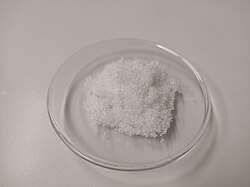
| Appearance | colorless solid |
| Odor | odorless |
| Density | 2.245 g/cm3 |
| Melting point | 197 °C (387 °F; 470 K) |
| Boiling point | 300 °C (572 °F; 573 K) (decomposes to form potassium pyrosulfate and water) |
Solubility in water
|
36.6 g/100 mL (0 °C) 49 g/100 mL (20 °C) 121.6 g/100 mL (100 °C) |
| Solubility | soluble in acetone, insoluble in ethanol. |
Magnetic susceptibility (χ)
|
−49.8·10−6 cm3/mol |
| Thermochemistry | |
Std enthalpy of
formation (ΔfH⦵298) |
−1163.3 kJ/mol |
| Hazards | |
| GHS labelling: | |
Pictograms
|
 
|
Signal word
|
Danger |
Hazard statements
|
H314, H335 |
Precautionary statements
|
P260, P264, P271, P280, P301+P330+P331, P303+P361+P353, P304+P340, P305+P351+P338, P310, P312, P321, P363, P403+P233, P405, P501 |
| Lethal dose or concentration (LD, LC): | |
LD50 (median dose)
|
2340 mg*kg−1 |
| Safety data sheet (SDS) | External MSDS |
| Related compounds | |
Related compounds
|
Potassium sulfate Sodium bisulfate |
Except where otherwise noted, data are given for materials in their standard state (at 25 °C [77 °F], 100 kPa).
Infobox references
| |


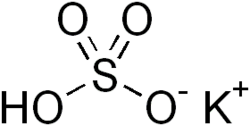
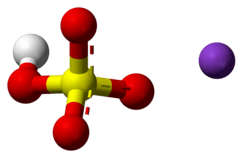
Potassium bisulfate (potassium bisulphate) is an inorganic compound with the chemical formula KHSO4 and is the potassium acid salt of sulfuric acid. It is a white, water-soluble solid.
Preparation
More than 1 million tons were produced in 1985 as the initial stage in the Mannheim process for producing potassium sulfate. The relevant conversion is the exothermic reaction of potassium chloride and sulfuric acid:[1][2]
- KCl + H2SO4 → HCl + KHSO4
Potassium bisulfate is a by-product in the production of nitric acid from potassium nitrate and sulfuric acid:[3]
- KNO3 + H2SO4 → KHSO4 + HNO3
Chemical properties
Thermal decomposition of potassium bisulfate forms potassium pyrosulfate:[1]
- 2 KHSO4 → K2S2O7 + H2O
Above 600 °C potassium pyrosulfate converts to potassium sulfate and sulfur trioxide:[4]
- K2S2O7 → K2SO4 + SO3
Uses
Potassium bisulfate is commonly used to prepare potassium bitartrate for winemaking.[5] Potassium bisulfate is also used as a disintegrating agent in analytical chemistry or as a precursor to prepare potassium persulfate, a powerful oxidizing agent.[6]
Occurrence
Mercallite, the mineralogical form of potassium bisulfate, occurs very rarely.[7] Misenite is another more complex form of potassium bisulfate with the formula K8H6(SO4)7.
References
- ^ a b Washington Wiley, Harvey (1895). Principles and Practice of Agricultural Analysis: Fertilizers. Easton, PA.: Chemical Publishing Co. p. 218. Retrieved 31 December 2015.
Potassium disulfate.
- ^ H. Schultz; G. Bauer; E. Schachl; F. Hagedorn; P. Schmittinger (2005). "Potassium Compounds". Ullmann's Encyclopedia of Industrial Chemistry. Weinheim: Wiley-VCH. doi:10.1002/14356007.a22_039. ISBN 978-3-527-30673-2.
- ^ Pradyot, Patnaik (2003). Handbook of Inorganic Chemicals. New York: McGraw-Hill. p. 636. ISBN 978-0-07-049439-8.
- ^ Iredelle Dillard Hinds, John (1908). Inorganic Chemistry: With the Elements of Physical and Theoretical Chemistry. New York: John Wiley & Sons. p. 547. Retrieved 31 December 2015.
Potassium disulfate.
- ^ Weisblatt, Jayne; Montney, Charles B. (2006). Chemical Compounds. ISBN 978-1-4144-0453-0.
- ^ Brauer, Georg (1963). Handbook of Preparative Inorganic Chemistry Vol. 1, 2nd Ed. New York: Academic Press. p. 392. ISBN 978-0-12-126601-1.
{{cite book}}: ISBN / Date incompatibility (help) - ^ "Mercallite: Mineral information, data and localities". mindat.org. Retrieved 2019-05-08.