Vanadium(II) chloride
| |||
| Names | |||
|---|---|---|---|
| IUPAC name
Vanadium(II) chloride
| |||
| Other names
Vanadous chloride
| |||
| Identifiers | |||
CAS Number
|
|||
3D model (JSmol)
|
|||
| ChemSpider | |||
| ECHA InfoCard | 100.031.057 | ||
| EC Number |
| ||
PubChem CID
|
|||
| RTECS number |
| ||
| UNII | |||
CompTox Dashboard (EPA)
|
|||
InChI
| |||
SMILES
| |||
| Properties | |||
Chemical formula
|
VCl2 | ||
| Molar mass | 121.847 g/mol | ||
| Appearance | pale green solid | ||
| Density | 3.230 g/cm3 | ||
| Melting point | 1,027 °C (1,881 °F; 1,300 K) | ||
| Boiling point | 1,506 °C (2,743 °F; 1,779 K) | ||
Solubility in water
|
soluble | ||
Magnetic susceptibility (χ)
|
+2410.0·10−6 cm3/mol | ||
| Structure | |||
Crystal structure
|
CdI2 | ||
Coordination geometry
|
octahedral | ||
| Hazards | |||
| Occupational safety and health (OHS/OSH): | |||
Main hazards
|
Reacts with oxygen rapidly | ||
| GHS labelling:[1] | |||
Pictograms
|
 
| ||
Signal word
|
Danger | ||
Hazard statements
|
H302, H314 | ||
Precautionary statements
|
P260, P264, P270, P280, P301+P312, P301+P330+P331, P303+P361+P353, P304+P340, P305+P351+P338, P310, P330, P363, P405 | ||
| Related compounds | |||
Other anions
|
vanadium(II) fluoride, vanadium(II) bromide, vanadium(II) iodide | ||
Other cations
|
titanium(II) chloride, chromium(II) chloride | ||
Related compounds
|
vanadium(III) chloride | ||
Except where otherwise noted, data are given for materials in their standard state (at 25 °C [77 °F], 100 kPa).
Infobox references
| |||
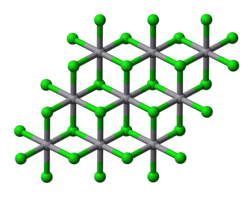
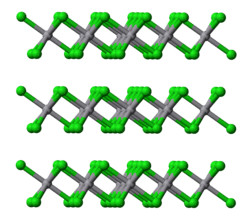


Vanadium(II) chloride is the inorganic compound with the formula VCl2, and is the most reduced vanadium chloride. Vanadium(II) chloride is an apple-green solid that dissolves in water to give purple solutions.[2]
Properties
VCl2 dissolves in water to give the purple hexaaquo ion [V(H2O)6]2+. Evaporation of such solutions produces crystals of [V(H2O)6]Cl2.[3]
Structure
Solid VCl2 adopts the cadmium iodide structure, featuring octahedral coordination geometry. VBr2 and VI2 are structurally and chemically similar to the dichloride. All have the d3 configuration, with a quartet ground state, akin to Cr(III).[4]
Preparation
Solid VCl2 is prepared by disproportionation of vanadium trichloride, which leaves a residue of VCl2 after evaporation of the tetrachloride:[2]
- 2 VCl3 → VCl2 + VCl4
The trichloride can also be reduced by heating under flowing hydrogen:[5]
- 2 VCl3 + H2 → 2 VCl2 + 2 HCl
Uses
Vanadium dichloride is used as a specialty reductant in organic chemistry. As an aqueous solution, it converts cyclohexylnitrate to cyclohexanone. It reduces phenyl azide into aniline.[6]
References
- ^ "Vanadium dichloride". pubchem.ncbi.nlm.nih.gov. Retrieved 12 December 2021.
- ^ a b Young, R. C.; Smith, M. E. "Vanadium(II) Chloride" Inorganic Syntheses, 1953, volume IV, page 126-127.doi:10.1002/9780470132357.ch42
- ^ Martin Pomerantz, Gerald L. Combs, N. L. Dassanayake, "Vanadium Dichloride Solution" Inorganic Syntheses, 1982, vol. XXI, pp. 185–187. doi:10.1002/9780470132524.ch42
- ^ Holleman, A. F.; Wiberg, E. "Inorganic Chemistry" Academic Press: San Diego, 2001. ISBN 0-12-352651-5.
- ^ G. Brauer (1963). "Vanadium(II) Chloride". In G. Brauer (ed.). Handbook of Preparative Inorganic Chemistry, 2nd Ed. Vol. 2. NY, NY: Academic Press. p. 1256.
- ^ Vanasse, Benoit; O'Brien, Michael K. (2001). "Vanadium(II) Chloride". Encyclopedia of Reagents for Organic Synthesis. doi:10.1002/047084289X.rv002. ISBN 0471936235.