Zirconium tetrafluoride
-fluorid.png) | |
| Names | |
|---|---|
| IUPAC names
Zirconium(IV) fluoride
Zirconium tetrafluoride | |
| Identifiers | |
CAS Number
|
|
3D model (JSmol)
|
|
| ChemSpider | |
| ECHA InfoCard | 100.029.107 |
| EC Number |
|
PubChem CID
|
|
| UNII | |
CompTox Dashboard (EPA)
|
|
InChI
| |
SMILES
| |
| Properties | |
Chemical formula
|
ZrF4 |
| Molar mass | 167.21 g/mol |
| Appearance | white crystalline powder |
| Density | 4.43 g/cm3 (20 °C) |
| Melting point | 910 °C (1,670 °F; 1,180 K) |
Solubility in water
|
1.32 g/100mL (20 °C) 1.388 g/100mL (25 °C) |
| Structure | |
Crystal structure
|
Monoclinic, mS60 |
Space group
|
C12/c1, No. 15 |
| Hazards | |
| GHS labelling: | |
Pictograms
|

|
Signal word
|
Danger |
Hazard statements
|
H314 |
Precautionary statements
|
P260, P264, P280, P301+P330+P331, P302+P361+P354, P304+P340, P305+P354+P338, P316, P321, P363, P405, P501 |
| Flash point | Non-flammable |
| Lethal dose or concentration (LD, LC): | |
LD50 (median dose)
|
98 mg/kg (oral, mouse) 98 mg/kg (oral, rat)[1] |
| Related compounds | |
Other anions
|
Zirconium(IV) chloride Zirconium(IV) bromide Zirconium(IV) iodide |
Other cations
|
Titanium(IV) fluoride Hafnium(IV) fluoride |
Except where otherwise noted, data are given for materials in their standard state (at 25 °C [77 °F], 100 kPa).
Infobox references
| |


Zirconium(IV) fluoride describes members of a family inorganic compounds with the formula ZrF4(H2O)x. All are colorless, diamagnetic solids. Anhydrous Zirconium(IV) fluoride is a component of ZBLAN fluoride glass.[2]
Structure
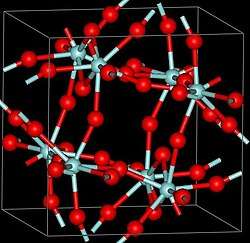
Three crystalline phases of ZrF4 have been reported, the stable β phase (monoclinic, space group I2/c) , α (tetragonal, space group P42/m) which is a high-temperature meta-stable form that can be stabilized by quenching. The γ-form (monoclinic, space group P21/c) is a high-pressure phase, forming at pressures between (4-8 GPa)[3]. α and γ phases are unstable and transform into the β phase at 400[4] and 723°C[3] respectively. There also exists an amorphous phase[3].
Zirconium(IV) fluoride forms several hydrates. The trihydrate has the structure (μ−F)2[ZrF3(H2O)3]2.[5]
Preparation and reactions
Zirconium fluoride can be produced by several methods. Zirconium dioxide reacts with hydrogen fluoride and hydrofluoric acid to afford the anhydrous and monohydrates:
- ZrO2 + 4 HF → ZrF4 + 2 H2O
The reaction of Zr metal reacts at high temperatures with HF as well:
- Zr + 4 HF → ZrF4 + 2 H2
Zirconium dioxide reacts at 200 °C with solid ammonium bifluoride to give the heptafluorozirconate salt, which can be converted to the tetrafluoride at 500 °C:
- 2ZrO2 + 7 (NH4)HF2 → 2 (NH4)3ZrF7 + 4 H2O + NH3
- (NH4)3ZrF7 → ZrF4 + 3 HF + 3 NH3
Addition of hydrofluoric acid to solutions of zirconium nitrate precipitates solid monohydrate. Hydrates of zirconium tetrafluoride can be dehydrated by heating under a stream of hydrogen fluoride.
Zirconium fluoride can be purified by distillation or sublimation.[2]
Zirconium fluoride forms double salts with other fluorides. The most prominent is potassium hexafluorozirconate, formed by fusion of potassium fluoride and zirconium tetrafluoride:[6]
- ZrF4 + 2 KF → K2ZrF6
Applications
The major and perhaps only commercial application of zirconium fluoride is as a precursor to ZBLAN glasses.[2]
Mixture of sodium fluoride, zirconium fluoride, and uranium tetrafluoride (53-41-6 mol.%) was used as a coolant in the Aircraft Reactor Experiment. A mixture of lithium fluoride, beryllium fluoride, zirconium fluoride, and uranium-233 tetrafluoride was used in the Molten-Salt Reactor Experiment. (Uranium-233 is used in the thorium fuel cycle reactors.)
References
- ^ "Zirconium compounds (as Zr)". Immediately Dangerous to Life or Health Concentrations. National Institute for Occupational Safety and Health.
- ^ a b c Nielsen, Ralph (2000). "Zirconium and Zirconium Compounds". Ullmann's Encyclopedia of Industrial Chemistry. doi:10.1002/14356007.a28_543. ISBN 3527306730.
- ^ a b c Laval, J.-P. (2014-08-15). "Crystal chemistry of anion-excess ReO3-related phases. III". Acta Crystallographica Section C: Structural Chemistry. 70 (8): 742–748. doi:10.1107/S2053229614014338. ISSN 2053-2296.
- ^ Paul L. Brown; Federico J. Mompean; Jane Perrone; Myriam Illemassène (2005). Chemical thermodynamics of zirconium. Gulf Professional Publishing. p. 144. ISBN 0-444-51803-7.
- ^ Greenwood, Norman N.; Earnshaw, Alan (1997). Chemistry of the Elements (2nd ed.). Butterworth-Heinemann. p. 965. doi:10.1016/C2009-0-30414-6. ISBN 978-0-08-037941-8.
- ^ Meshri, Dayal T. (2000), "Fluorine compounds, inorganic, titanium", Kirk-Othmer Encyclopedia of Chemical Technology, New York: John Wiley, doi:10.1002/0471238961.2009200113051908.a01, ISBN 9780471238966
- ORNL/TM-2006/12 Assessment of Candidate Molten Salt Coolants for the Advanced High-Temperature Reactor (AHTR), March 2006 (Accessed 2008/9/18)