Ammonium fluoride
| |||
 | |||
 | |||
| Names | |||
|---|---|---|---|
| IUPAC name
Ammonium fluoride
| |||
| Other names
Neutral ammonium fluoride
| |||
| Identifiers | |||
CAS Number
|
|||
3D model (JSmol)
|
|||
| ChEBI | |||
| ChemSpider | |||
| ECHA InfoCard | 100.031.975 | ||
| EC Number |
| ||
PubChem CID
|
|||
| RTECS number |
| ||
| UNII | |||
| UN number | 2505 | ||
CompTox Dashboard (EPA)
|
|||
InChI
| |||
SMILES
| |||
| Properties | |||
Chemical formula
|
NH4F | ||
| Molar mass | 37.037 g/mol | ||
| Appearance | White crystalline solid hygroscopic | ||
| Density | 1.009 g/cm3 | ||
| Melting point | 100 °C (212 °F; 373 K) (decomposes) | ||
Solubility in water
|
83.5 g/100 ml (25 °C) [1] | ||
| Solubility | slightly soluble in alcohol, insoluble in liquid ammonia | ||
Magnetic susceptibility (χ)
|
−23.0×10⁻⁶ cm3/mol | ||
| Structure | |||
Crystal structure
|
Wurtzite structure (hexagonal) | ||
| Hazards | |||
| GHS labelling:[2] | |||
Pictograms
|
 
| ||
Signal word
|
Danger | ||
Hazard statements
|
H301, H311, H314, H330, H331 | ||
Precautionary statements
|
P260, P264, P270, P271, P280, P284, P301+P310, P301+P330+P331, P302+P352, P303+P361+P353, P304+P340, P305+P351+P338, P310, P311, P312, P320, P321, P330, P361, P363, P403+P233, P405, P501 | ||
| NFPA 704 (fire diamond) | 
3
0
0 | ||
| Flash point | Non-flammable | ||
| Safety data sheet (SDS) | ICSC 1223 | ||
| Related compounds | |||
Other anions
|
Ammonium chloride Ammonium bromide Ammonium iodide | ||
Other cations
|
Sodium fluoride Potassium fluoride | ||
Related compounds
|
Ammonium bifluoride | ||
Except where otherwise noted, data are given for materials in their standard state (at 25 °C [77 °F], 100 kPa).
Infobox references
| |||
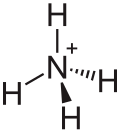


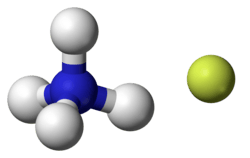
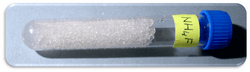
Ammonium fluoride is the inorganic compound with the formula NH4F. It crystallizes as small colourless prisms, having a sharp saline taste, and is highly soluble in water. Like all fluoride salts, it is moderately toxic in both acute and chronic overdose.[3]
Crystal structure
Ammonium fluoride adopts the wurtzite crystal structure, in which both the ammonium cations and the fluoride anions are stacked in ABABAB... layers, each being tetrahedrally surrounded by four of the other. There are N−H···F hydrogen bonds between the anions and cations.[4] This structure is very similar to ice, and ammonium fluoride is the only substance which can form mixed crystals with water.[5]
Reactions
On passing hydrogen fluoride gas (in excess) through the salt, ammonium fluoride absorbs the gas to form the addition compound ammonium bifluoride. The reaction occurring is:
- NH4F + HF → NH4HF2
Ammonium fluoride sublimes when heated—a property common among ammonium salts. In the sublimation, the salt decomposes to ammonia and hydrogen fluoride; the two gases can still recombine, i.e. the reaction is reversible:
- [NH4]F ⇌ NH3 + HF
Uses
This substance is commonly called "commercial ammonium fluoride". The word "neutral" is sometimes added to "ammonium fluoride" to represent the neutral salt [NH4]F as opposed to the "acid salt" (NH4HF2). The acid salt is usually used in preference to the neutral salt in the etching of glass and related silicates. This property is shared among all soluble fluorides. For this reason it cannot be handled in glass test tubes or apparatus during laboratory work.
Ammonium fluoride is a critical component of buffered oxide etch (BOE), a wet etchant used in microfabrication. It acts as the buffering agent in a solution of concentrated HF, creating an etchant with a more controllable rate of etching (than that of simple concentrated HF solutions).[6]
It is also used for preserving wood, as a mothproofing agent, in printing and dyeing textiles, and as an antiseptic in breweries.[7]
References
- ^ "Ammonium Fluoride". pubchem.ncbi.nlm.nih.gov.
- ^ "Ammonium Fluoride". pubchem.ncbi.nlm.nih.gov.
- ^ Bălan, H (January 2012). "Fluoride--the danger that we must avoid" (PDF). Romanian journal of internal medicine = Revue roumaine de medecine interne. 50 (1): 61–9. PMID 22788094. Retrieved 10 December 2025.
- ^ A. F. Wells, Structural Inorganic Chemistry, 5th ed., Oxford University Press, Oxford, UK, 1984.
- ^ Brill, R.; Zaromb, S. (1954). "Mixed Crystals of Ice and Ammonium Fluoride". Nature. 173 (4398): 316–317. Bibcode:1954Natur.173..316B. doi:10.1038/173316a0. S2CID 4146351.
- ^ Wolf, Stanley; Tauber, Richard (1986). Silicon Processing for the VLSI Era: Volume 1 - Process Technology. pp. 532–533. ISBN 978-0-9616721-3-3.
- ^ Aigueperse, Jean; Paul Mollard; Didier Devilliers; Marius Chemla; Robert Faron; Renée Romano; Jean Pierre Cuer (2005). "Fluorine Compounds, Inorganic". In Ullmann (ed.). Encyclopedia of Industrial Chemistry. Weinheim: Wiley-VCH. doi:10.1002/14356007.a11_307. ISBN 3-527-30673-0.
