2-Heptanol
 | |
| Names | |
|---|---|
| Preferred IUPAC name
Heptan-2-ol | |
| Other names
s-Heptyl alcohol
| |
| Identifiers | |
CAS Number
|
|
3D model (JSmol)
|
|
| ChEBI | |
| ChEMBL | |
| ChemSpider | |
| ECHA InfoCard | 100.008.041 |
PubChem CID
|
|
| UNII | |
CompTox Dashboard (EPA)
|
|
InChI
| |
SMILES
| |
| Properties | |
Chemical formula
|
C7H16O |
| Molar mass | 116.204 g·mol−1 |
| Density | 0.817 g/mL |
| Melting point | −30.2 °C (−22.4 °F; 243.0 K)[2] |
| Boiling point | 159 °C (318 °F; 432 K) |
Solubility in water
|
3.3 g/L |
| Solubility | soluble in ethanol, diethyl ether |
| Viscosity | 3.955 mPa·s |
| Hazards | |
| Flash point | 71 °C (160 °F; 344 K) |
Except where otherwise noted, data are given for materials in their standard state (at 25 °C [77 °F], 100 kPa).
Infobox references
| |


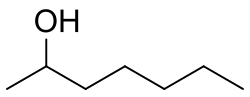
2-Heptanol is a chemical compound which is an isomer of heptanol. It is a secondary alcohol with the hydroxyl on the second carbon of the straight seven-carbon chain. The compound is flammable and irritant, and through inhalation, ingestion or though skin it can enter into the body. [3]
2-Heptanol is chiral, so (R)- and (S)-isomers exist.
See also
- 1-Heptanol
- 3-Heptanol
- 4-Heptanol
References
- ^ Lide, David R. (1998), Handbook of Chemistry and Physics (87 ed.), Boca Raton, Florida: CRC Press, pp. 3–300, 6–189, 8–109, 16–25, ISBN 0-8493-0594-2
- ^ "543-49-7(2-Heptanol)". chemicalbook.com.
- ^ PubChem. "2-Heptanol". pubchem.ncbi.nlm.nih.gov. Retrieved 2024-10-19.
Alcohols | |||||||||||||||||
|---|---|---|---|---|---|---|---|---|---|---|---|---|---|---|---|---|---|
| By consumption |
| ||||||||||||||||
| Primary alcohols (1°) |
| ||||||||||||||||
| Secondary alcohols (2°) | |||||||||||||||||
| Tertiary alcohols (3°) |
| ||||||||||||||||
| Hydric alcohols |
| ||||||||||||||||
| Amyl alcohols | |||||||||||||||||
| Aromatic alcohols | |||||||||||||||||
| Saturated fatty alcohols |
| ||||||||||||||||
| Branched and unsaturated fatty alcohols |
| ||||||||||||||||
| Sugar alcohols |
| ||||||||||||||||
| Terpene alcohols |
| ||||||||||||||||
| Dialcohols |
| ||||||||||||||||
| Trialcohols | |||||||||||||||||
| Sterols | |||||||||||||||||
| Fluoroalcohols |
| ||||||||||||||||
| Preparations |
| ||||||||||||||||
| Reactions |
| ||||||||||||||||
| |||||||||||||||||
