o-Xylene
| |||
| Names | |||
|---|---|---|---|
| Preferred IUPAC name
1,2-Xylene[1] | |||
| Systematic IUPAC name
1,2-Dimethylbenzene[1] | |||
| Other names
o-Xylene,[1] o-Xylol
| |||
| Identifiers | |||
CAS Number
|
|||
3D model (JSmol)
|
|||
Beilstein Reference
|
1815558 | ||
| ChEBI | |||
| ChEMBL | |||
| ChemSpider | |||
| DrugBank | |||
| ECHA InfoCard | 100.002.203 | ||
| EC Number |
| ||
Gmelin Reference
|
67796 | ||
| KEGG | |||
PubChem CID
|
|||
| RTECS number |
| ||
| UNII | |||
| UN number | 1307 | ||
CompTox Dashboard (EPA)
|
|||
InChI
| |||
SMILES
| |||
| Properties | |||
Chemical formula
|
C8H10 | ||
| Molar mass | 106.168 g·mol−1 | ||
| Appearance | Colorless liquid | ||
| Density | 0.88 g/ml | ||
| Melting point | −24 °C (−11 °F; 249 K) | ||
| Boiling point | 144.4 °C (291.9 °F; 417.5 K) | ||
Solubility in water
|
0.02% (20 °C)[2] | ||
| Solubility in ethanol | very soluble | ||
| Solubility in diethyl ether | very soluble | ||
| Vapor pressure | 7 mmHg (20°C)[2] | ||
Magnetic susceptibility (χ)
|
−77.78·10−6 cm3/mol | ||
Refractive index (nD)
|
1.50545 | ||
| Viscosity | 1.1049 cP at 0 °C 0.8102 cP at 20 °C | ||
| Structure | |||
Dipole moment
|
0.64 D[3] | ||
| Hazards | |||
| Occupational safety and health (OHS/OSH): | |||
Main hazards
|
Mildly toxic | ||
| GHS labelling: | |||
Pictograms
|
  
| ||
Signal word
|
Danger | ||
Hazard statements
|
H225, H226, H304, H305, H312, H315, H319, H332, H335, H412 | ||
Precautionary statements
|
P210, P233, P240, P241, P242, P243, P261, P264, P271, P273, P280, P301+P310, P302+P352, P303+P361+P353, P304+P312, P304+P340, P305+P351+P338, P312, P321, P322, P331, P332+P313, P337+P313, P362, P363, P370+P378, P403+P233, P403+P235, P405, P501 | ||
| NFPA 704 (fire diamond) | 
2
3
0 | ||
| Flash point | 32 °C (90 °F; 305 K) | ||
Autoignition
temperature |
463 °C (865 °F; 736 K)[4] | ||
| Explosive limits | 0.9%-6.7%[2] | ||
Threshold limit value (TLV)
|
100 ppm[4] (TWA), 150 ppm[4] (STEL) | ||
| Lethal dose or concentration (LD, LC): | |||
LD50 (median dose)
|
4300 mg/kg (rats, orally)[5] | ||
LCLo (lowest published)
|
6125 ppm (rat, 12 hr) 6125 ppm (human, 12 hr)[6] | ||
| NIOSH (US health exposure limits): | |||
PEL (Permissible)
|
TWA 100 ppm (435 mg/m3)[2] | ||
REL (Recommended)
|
TWA 100 ppm (435 mg/m3) ST 150 ppm (655 mg/m3)[2] | ||
IDLH (Immediate danger)
|
900 ppm[2] | ||
| Safety data sheet (SDS) | External MSDS | ||
| Related compounds | |||
Related aromatic hydrocarbons
|
m-xylene p-xylene toluene | ||
| Supplementary data page | |||
| O-Xylene (data page) | |||
Except where otherwise noted, data are given for materials in their standard state (at 25 °C [77 °F], 100 kPa).
Infobox references
| |||
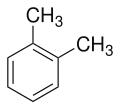
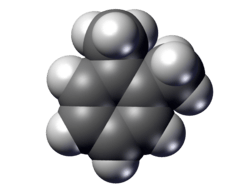


o-Xylene (ortho-xylene) is an aromatic hydrocarbon with the formula C6H4(CH3)2, with two methyl substituents bonded to adjacent carbon atoms of a benzene ring (the ortho configuration). It is a constitutional isomer of m-xylene and p-xylene, the mixture being called xylene or xylenes. o-Xylene is a colourless slightly oily flammable liquid.[7]
Production and use
Petroleum contains about one weight percent xylenes. Most o-xylene is produced by cracking petroleum, which affords a distribution of aromatic compounds, including xylene isomers. m-Xylene is isomerized to o-xylene. Net production was approximately 500,000 tons in the year 2000.
o-Xylene is largely used in the production of phthalic anhydride, which is a precursor to many materials, drugs, and other chemicals.[7] Related to their easy oxidation, the methyl groups are susceptible to halogenation. When treated with elemental bromine, these groups are brominated, yielding xylylene dibromide:[8]
- C6H4(CH3)2 + 2 Br2 → C6H4(CH2Br)2 + 2 HBr
Toxicity and exposure
Xylenes are not acutely toxic, for example the LD50 (rat, oral) is 4300 mg/kg. Effects vary with animal and xylene isomer. Concerns with xylenes focus on narcotic effects.[7]
References
- ^ a b c Nomenclature of Organic Chemistry : IUPAC Recommendations and Preferred Names 2013 (Blue Book). Cambridge: The Royal Society of Chemistry. 2014. pp. 121, 139, 653. doi:10.1039/9781849733069. ISBN 978-0-85404-182-4.
- ^ a b c d e f NIOSH Pocket Guide to Chemical Hazards. "#0668". National Institute for Occupational Safety and Health (NIOSH).
- ^ Rudolph, H.D.; Walzer, K.; Krutzik, Irmhild (1973). "Microwave spectrum, barrier for methyl rotation, methyl conformation, and dipole moment of ortho-xylene". Journal of Molecular Spectroscopy. 47 (2): 314. Bibcode:1973JMoSp..47..314R. doi:10.1016/0022-2852(73)90016-7.
- ^ a b c "o-Xylene". International Chemical Safety Cards. ICSC/NIOSH. July 1, 2014.
- ^ O-xylene toxicity
- ^ "Xylene (o-, m-, p-isomers)". Immediately Dangerous to Life or Health Concentrations. National Institute for Occupational Safety and Health.
- ^ a b c Fabri, Jörg; Graeser, Ulrich; Simo, Thomas A. (2000). "Xylenes". Ullmann's Encyclopedia of Industrial Chemistry. Weinheim: Wiley-VCH. doi:10.1002/14356007.a28_433. ISBN 978-3-527-30673-2.
- ^ Emily F. M. Stephenson (1954). "o-Xylylene Dibromide". Organic Syntheses. 34: 100. doi:10.15227/orgsyn.034.0100.