1-Heptanol
 | |
 | |
| Names | |
|---|---|
| Preferred IUPAC name
Heptan-1-ol | |
| Other names
Heptyl alcohol
n-Heptyl alcohol Enanthic alcohol | |
| Identifiers | |
CAS Number
|
|
3D model (JSmol)
|
|
| ChEBI | |
| ChEMBL | |
| ChemSpider | |
| ECHA InfoCard | 100.003.544 |
PubChem CID
|
|
| UNII | |
CompTox Dashboard (EPA)
|
|
InChI
| |
SMILES
| |
| Properties | |
Chemical formula
|
C7H16O |
| Molar mass | 116.204 g·mol−1 |
| Density | 0.8187 g/cm3 |
| Melting point | −34.6 °C (−30.3 °F; 238.6 K) |
| Boiling point | 175.8 °C (348.4 °F; 448.9 K) |
Magnetic susceptibility (χ)
|
−91.7·10−6 cm3/mol |
Refractive index (nD)
|
1.423 |
| Thermochemistry | |
Std enthalpy of
combustion (ΔcH⦵298) |
−4637.9 kJ/mol |
| Hazards | |
| NFPA 704 (fire diamond) | 
2
2
0 |
| Flash point | 76 °C (169 °F; 349 K) |
Except where otherwise noted, data are given for materials in their standard state (at 25 °C [77 °F], 100 kPa).
Infobox references
| |


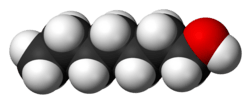
1-Heptanol is an alcohol with a seven carbon chain and the structural formula of CH3(CH2)6OH.[1] It is a clear colorless liquid that is very slightly soluble in water, but miscible with ether and ethanol.
Overview
There are three other isomers of heptanol that have a straight chain, 2-heptanol, 3-heptanol, and 4-heptanol, which differ by the location of the alcohol functional group.
Heptanol is commonly used in cardiac electrophysiology experiments to block gap junctions and increase axial resistance between myocytes. Increasing axial resistance will decrease conduction velocity and increase the heart's susceptibility to reentrant excitation and sustained arrhythmias.
1-Heptanol has a pleasant smell and is used in cosmetics for its fragrance.
See also
References
- ^ CRC Handbook of Chemistry and Physics (65th ed.).
Alcohols | |||||||||||||||||
|---|---|---|---|---|---|---|---|---|---|---|---|---|---|---|---|---|---|
| By consumption |
| ||||||||||||||||
| Primary alcohols (1°) |
| ||||||||||||||||
| Secondary alcohols (2°) | |||||||||||||||||
| Tertiary alcohols (3°) |
| ||||||||||||||||
| Hydric alcohols |
| ||||||||||||||||
| Amyl alcohols | |||||||||||||||||
| Aromatic alcohols | |||||||||||||||||
| Saturated fatty alcohols |
| ||||||||||||||||
| Branched and unsaturated fatty alcohols |
| ||||||||||||||||
| Sugar alcohols |
| ||||||||||||||||
| Terpene alcohols |
| ||||||||||||||||
| Dialcohols |
| ||||||||||||||||
| Trialcohols | |||||||||||||||||
| Sterols | |||||||||||||||||
| Fluoroalcohols |
| ||||||||||||||||
| Preparations |
| ||||||||||||||||
| Reactions |
| ||||||||||||||||
| |||||||||||||||||
