2-Hexanol
 | |
-Hexan-2-ol_3D_ball.png) | |
| Names | |
|---|---|
| Preferred IUPAC name
Hexan-2-ol | |
| Identifiers | |
CAS Number
|
|
3D model (JSmol)
|
|
| ChEBI | |
| ChEMBL | |
| ChemSpider | |
| ECHA InfoCard | 100.009.975 |
PubChem CID
|
|
| UNII | |
CompTox Dashboard (EPA)
|
|
InChI
| |
SMILES
| |
| Properties | |
Chemical formula
|
C6H14O |
| Molar mass | 102.177 g·mol−1 |
| Density | 0.81 g/mL |
| Melting point | −23 °C (−9 °F; 250 K) |
| Boiling point | 140 °C (284 °F; 413 K) |
Solubility in water
|
14 g/L |
| Solubility | soluble in ethanol, diethyl ether |
| Thermochemistry | |
Std enthalpy of
formation (ΔfH⦵298) |
−392.0 kJ·mol−1 (liquid) −333.5 kJ·mol−1 (gas) |
| Hazards | |
| Flash point | 45 °C (113 °F; 318 K)[2] |
Except where otherwise noted, data are given for materials in their standard state (at 25 °C [77 °F], 100 kPa).
Infobox references
| |


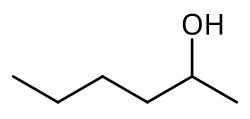
2-Hexanol (hexan-2-ol) is a six-carbon alcohol in which the hydroxy group (OH) is located on the second carbon atom. Its chemical formula is C6H14O or C6H13OH. It is an isomer of the other hexanols. 2-Hexanol has a chiral center and can be resolved into two different enantiomers.
Its toxicity is based on metabolism to hexane-2,5-dione.[3]
References
- ^ Lide, David R. (1998), Handbook of Chemistry and Physics (87 ed.), Boca Raton, Florida: CRC Press, pp. 3–310, 5–47, 8–106, ISBN 0-8493-0594-2
- ^ "2-Hexanol". Chemspider.
- ^ Stephen R. Clough, Leyna Mulholland (2005). "Hexane". Encyclopedia of Toxicology (Second ed.). ISBN 978-0-12-369400-3.
Alcohols | |||||||||||||||||
|---|---|---|---|---|---|---|---|---|---|---|---|---|---|---|---|---|---|
| By consumption |
| ||||||||||||||||
| Primary alcohols (1°) |
| ||||||||||||||||
| Secondary alcohols (2°) | |||||||||||||||||
| Tertiary alcohols (3°) |
| ||||||||||||||||
| Hydric alcohols |
| ||||||||||||||||
| Amyl alcohols | |||||||||||||||||
| Aromatic alcohols | |||||||||||||||||
| Saturated fatty alcohols |
| ||||||||||||||||
| Branched and unsaturated fatty alcohols |
| ||||||||||||||||
| Sugar alcohols |
| ||||||||||||||||
| Terpene alcohols |
| ||||||||||||||||
| Dialcohols |
| ||||||||||||||||
| Trialcohols | |||||||||||||||||
| Sterols | |||||||||||||||||
| Fluoroalcohols |
| ||||||||||||||||
| Preparations |
| ||||||||||||||||
| Reactions |
| ||||||||||||||||
| |||||||||||||||||
