Silver cyanate
 | |
| Names | |
|---|---|
| Systematic IUPAC name
Silver(I) cyanate | |
| Identifiers | |
CAS Number
|
|
3D model (JSmol)
|
|
| ChemSpider | |
| ECHA InfoCard | 100.020.007 |
PubChem CID
|
|
CompTox Dashboard (EPA)
|
|
InChI
| |
SMILES
| |
| Properties | |
Chemical formula
|
AgOCN |
| Molar mass | 149.885 g/mol |
| Appearance | colourless |
| Density | 4g/cm3 |
| Melting point | 652 °C (1,206 °F; 925 K) |
| Boiling point | 1,085 °C (1,985 °F; 1,358 K) |
Solubility in water
|
Soluble in ammonia, nitric acid, potassium cyanide, ammonium hydroxide. Insoluble in alcohol and dilute acids.[1] |
| Hazards | |
| GHS labelling: | |
Pictograms
|
|
Signal word
|
Warning |
Hazard statements
|
H302+H312+H332 |
Precautionary statements
|
P261, P270, P280, P301+P312+P330, P302+P352+P312, P304+P340+P312, P362+P364, P501 |
| NFPA 704 (fire diamond) | 
2
0
0 |
| Safety data sheet (SDS) | MSDS |
Except where otherwise noted, data are given for materials in their standard state (at 25 °C [77 °F], 100 kPa).
Infobox references
| |

Silver cyanate is the cyanate salt of silver. It is a beige to gray powder.
Structure
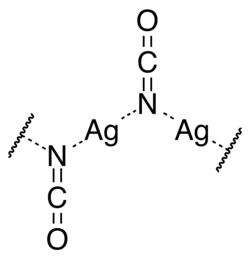
Silver cyanate crystallises in the monoclinic crystal system in space group P21/m with parameters a = 547.3 pm, b = 637.2 pm, c = 341.6 pm, and β = 91°. Each unit cell contains two cyanate ions and two silver ions. The silver ions are each equidistant from two nitrogen atoms forming a straight N–Ag–N group. The nitrogen atoms are each coordinated to two silver atoms, so that there are zigzag chains of alternating silver and nitrogen atoms going in the direction of the monoclinic "b" axis, with the cyanate ions perpendicular to that axis.[2]
Preparation
Silver cyanate can be made by the reaction of potassium cyanate with silver nitrate in aqueous solution, from which it precipitates as a solid:
- AgNO3 + KNCO → Ag(NCO) + K+ + NO−3
Alternatively, a reaction with urea, forming ammonium nitrate as a byproduct may be used:
- AgNO3 + CO(NH2)2 → AgNCO + NH4NO3
This is analogous to the reaction used for the industrial production of sodium cyanate.[3]
Reactions
Silver cyanate reacts with nitric acid to form silver nitrate, carbon dioxide, and ammonium nitrate:[4]
- AgNCO + 2 HNO3 + H2O → AgNO3 + CO2 + NH4NO3
See also
References
- ^ "3315-16-0 - Silver cyanate, 98% - 45411 - Alfa Aesar". www.alfa.com. Retrieved 2022-05-25.
- ^ D. Britton, J. D. Dunitz: The crystal structure of silver cyanate, Acta Crystallogr. (1965). 18, 424–428, doi:10.1107/S0365110X65000944
- ^ Willy Kühne (1868), Lehrbuch der physiologischen Chemie (in German)
- ^ J. Milbauer: Bestimmung und Trennung der Cyanate, Cyanide, Rhodanide und Sulfide in Fresenius' Journal of Analytical Chemistry 42 (1903) 77–95, doi:10.1007/BF01302741.