Silver lactate
 | |
| Names | |
|---|---|
| Other names
silver; 1-hydroxy-1-oxopropan-2-olate
| |
| Identifiers | |
CAS Number
|
|
3D model (JSmol)
|
|
| ChemSpider | |
| ECHA InfoCard | 100.036.221 |
| EC Number |
|
PubChem CID
|
|
CompTox Dashboard (EPA)
|
|
InChI
| |
SMILES
| |
| Properties | |
Chemical formula
|
CH3CH(OH)COOAg |
| Molar mass | 196.93 g/mol |
| Appearance | Gray to purple powder or flakes |
| Melting point | 120–122 °C (248–252 °F; 393–395 K) |
| Boiling point | 227.6 °C (441.7 °F; 500.8 K) |
Solubility in water
|
Soluble |
| Solubility | Slightly soluble in ethanol |
| Hazards | |
| GHS labelling: | |
Pictograms
|

|
Signal word
|
Warning |
Hazard statements
|
H315, H319, H335 |
Precautionary statements
|
P302, P305, P338, P351, P352 |
| NFPA 704 (fire diamond) | 
2
0
1 |
Except where otherwise noted, data are given for materials in their standard state (at 25 °C [77 °F], 100 kPa).
Infobox references
| |

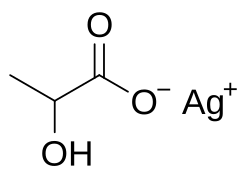
Silver lactate is an organic chemical compound, a salt of silver and lactic acid[1] with the formula CH3CH(OH)COOAg.[2][3] It forms light gray crystals.[4] A monohydrate (CH3CH(OH)COOAg•H2O) exists.
Synthesis
Silver lactate can be made by the reaction of silver carbonate with lactic acid.
Reactions
Silver lactate is a reagent for the precipitation of uric acid.[5]
The compound reacts with triphenylphosphine gold chloride in a mixed solvent of benzene and dichloromethane to obtain colorless triphenylphosphine gold lactate.[6]
The compound reacts with a tetraphosphine ligand, dppbpda, to obtain a coordination polymer [(dppbpda)Ag4(CH3CH(OH)COO)4]n.[7]
References
- ^ Hacker, Gerhard W.; Gu, Jiang (17 April 2002). Gold and Silver Staining: Techniques in Molecular Morphology. CRC Press. p. 62. ISBN 978-1-4200-4023-4. Retrieved 18 January 2022.
- ^ "Silver Lactate". American Elements. Retrieved 18 January 2022.
- ^ "Silver lactate". Sigma Aldrich. Retrieved 18 January 2022.
- ^ Hayat, M. A. (3 August 1995). Immunogold-Silver Staining: Principles, Methods, and Applications. CRC Press. p. 30. ISBN 978-0-8493-2449-9. Retrieved 18 January 2022.
- ^ Cornell University Medical Bulletin. 1928. p. 296. Retrieved 18 January 2022.
- ^ Fackler, John P.; Khan, M. Nazrul I.; King, Christopher; Staples, Richard J.; Winpenny, Richard E. P. (1 July 1991). "Decarboxylation of (triphenylphosphine)gold(I) carboxylates". Organometallics. 10 (7): 2178–2183. doi:10.1021/om00053a021. ISSN 0276-7333. Retrieved 23 January 2022.
- ^ Zhang, Min; Feng, Meng-Yao; Yan, Jia-Jun; Li, Hai-Yan; Young, David James; Li, Hong-Xi; Ren, Zhi-Gang (21 June 2021). "New Silver(I)-P4 Coordination Polymers Strongly Adsorb Congo Red to Yield Composites with Enhanced Photocurrent Responses". European Journal of Inorganic Chemistry. 2021 (23): 2262–2265. doi:10.1002/ejic.202100228. S2CID 235558940. Retrieved 23 January 2022.