Silver nitrite
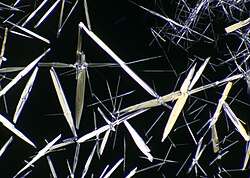 | |
| Names | |
|---|---|
| IUPAC name
Silver(I) nitrite
| |
| Other names
Argentous nitrite
| |
| Identifiers | |
CAS Number
|
|
3D model (JSmol)
|
|
| ChemSpider | |
| ECHA InfoCard | 100.029.128 |
| EC Number |
|
PubChem CID
|
|
| UNII | |
CompTox Dashboard (EPA)
|
|
InChI
| |
SMILES
| |
| Properties | |
Chemical formula
|
AgNO2 |
| Molar mass | 153.87 g/mol |
| Appearance | colorless to yellow crystals |
| Melting point | 140 °C (284 °F; 413 K) |
Solubility in water
|
0.155 g/100 mL (0 °C) 0.275 g/100 mL (15 °C) 1.363 g/100 mL (60 °C) |
| Solubility | insoluble in ethanol |
Magnetic susceptibility (χ)
|
−42.0·10−6 cm3/mol |
| Hazards | |
| GHS labelling:[1] | |
Pictograms
|
  
|
Signal word
|
Warning |
Hazard statements
|
H272, H302, H315, H319, H400 |
Precautionary statements
|
P210, P220, P221, P264, P270, P273, P280, P301+P312, P302+P352, P305+P351+P338, P321, P330, P332+P313, P337+P313, P362, P370+P378, P391, P501 |
| NFPA 704 (fire diamond) | 
2
0
2 |
| Safety data sheet (SDS) | Sigma-Aldrich |
Except where otherwise noted, data are given for materials in their standard state (at 25 °C [77 °F], 100 kPa).
Infobox references
| |

Silver nitrite is an inorganic compound with the formula AgNO2.[2]
Production
Silver nitrite is produced from the reaction between silver nitrate and an alkali nitrite, such as sodium nitrite.[3] Silver nitrite is much less soluble in water than silver nitrate, and a solution of silver nitrate will readily precipitate silver nitrite upon addition of sodium nitrite:
- AgNO3 + NaNO2 → NaNO3 + AgNO2
Alternatively, it can be produced by the reaction between silver sulfate and barium nitrite.
Applications
Silver nitrite has many applications. Notable examples include:
- The production of aniline compounds.
- General oxidizing agent.
- Victor Meyer type nucleophilic substitution reactions with organobromides or organoiodides forming nitro compounds.[3]
- Nitroalkene synthesis with nitryl iodide generated in-situ from silver nitrite and elemental iodine.[4]
- 1,2,3-Benzothiadiazoles synthesis via skeletal editing (S,N-heteroarene ring transformation) of variously functionalized 2-halobenzothiazoles and benzothiazolinones[5]
References
- ^ "Silver nitrite". pubchem.ncbi.nlm.nih.gov. Retrieved 15 December 2021.
- ^ American elements
- ^ a b Kornblum, N.; Ungnade, H. E. (1958). "1-Nitroöctane (Octane, 1-nitro-)" (PDF). Organic Syntheses. 38: 75. Retrieved 6 January 2014.
- ^ Waldman, Steve; Monte, Aaron, Monte; Bracey, Ann & Nichols, David (1996). "One-pot Claisen rearrangement/O-methylation/alkene isomerization in the synthesis of ortho-methoxylated phenylisopropylamines". Tetrahedron Letters. 37 (44): 7889–7892. doi:10.1016/0040-4039(96)01807-2.
{{cite journal}}: CS1 maint: multiple names: authors list (link) - ^ Nociarova, Jela; Purkait, Anisha; Gyepes, Robert; Hrobarik, Peter (2024). "Silver-Catalyzed Skeletal Editing of Benzothiazol-2(3H)-ones and 2-Halogen-Substituted Benzothiazoles as a Rapid Single-Step Approach to Benzo[1,2,3]Thiadiazoles". Organic Letters. 26: 619–624.