Except where otherwise noted, data are given for materials in their standard state (at 25 °C [77 °F], 100 kPa).
Infobox references
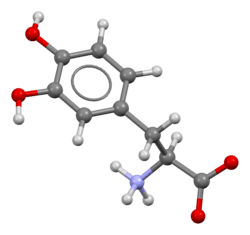
l-DOPA, also known as l-3,4-dihydroxyphenylalanine and used medically as levodopa, is made and used as part of the normal biology of some plants[2] and animals, including humans. Humans, as well as a portion of the other animals that utilize l-DOPA, make it via biosynthesis from the amino acid l-tyrosine.
l-DOPA is the precursor to the neurotransmitters dopamine, norepinephrine (noradrenaline), and epinephrine (adrenaline), which are collectively known as catecholamines. Furthermore, l-DOPA itself mediates neurotrophic factor release by the brain and central nervous system.[3][4] In some plant families (of the order Caryophyllales), l-DOPA is the central precursor of a biosynthetic pathway that produces a class of pigments called betalains.[5]
l-DOPA can be manufactured and in its pure form is sold as a drug with the INNTooltip International Nonproprietary Namelevodopa. As a drug, it is used in the treatment of Parkinson's disease and dopamine-responsive dystonia, as well as restless leg syndrome.[6]
l-DOPA has a counterpart with opposite chirality, d-DOPA. As is true for many molecules, the human body produces only one of these isomers (the l-DOPA form). The enantiomeric purity of l-DOPA may be analyzed by determination of the optical rotation or by chiral thin-layer chromatography.[7]
Biological role
Biosynthetic pathways for catecholamines and trace amines in the human brain[8][9][10]
In humans, catecholamines and phenethylaminergic trace amines are derived from the amino acid L-phenylalanine.
l-DOPA is produced from the amino acid l-tyrosine by the enzyme tyrosine hydroxylase. l-DOPA can act as an l-tyrosine mimetic and be incorporated into proteins by mammalian cells in place of l-tyrosine, generating protease-resistant and aggregate-prone proteins in vitro and may contribute to neurotoxicity with chronic l-DOPA administration.[11]
It is also the precursor for the monoamine or catecholamine neurotransmitters dopamine, norepinephrine (noradrenaline), and epinephrine (adrenaline). Dopamine is formed by the decarboxylation of l-DOPA by aromatic l-amino acid decarboxylase (AADC).
l-DOPA can be directly metabolized by catechol-O-methyl transferase to 3-O-methyldopa, and then further to vanillactic acid. This metabolic pathway is nonexistent in the healthy body, but becomes important after peripheral l-DOPA administration in patients with Parkinson's disease or in the rare cases of patients with AADC enzyme deficiency.[12]
l-Phenylalanine, l-tyrosine, and l-DOPA are all precursors to the biological pigment melanin. The enzyme tyrosinase catalyzes the oxidation of l-DOPA to the reactive intermediate dopaquinone, which reacts further, eventually leading to melanin oligomers. In addition, tyrosinase can convert tyrosine directly to l-DOPA in the presence of a reducing agent such as ascorbic acid.[13]
Chemistry
L-DOPA, also known as L-3,4-dihydroxyphenylalanine or L-3-hydroxytyrosine, is an aromatic amino acid derived from L-phenylalanine and L-tyrosine. It is a phenethylamine, monoamine, and catecholamine, and is a biological precursor of the neurotransmitters dopamine (3,4-dihydroxyphenethylamine), norepinephrine (3,4,β-trihydroxyphenethylamine), and epinephrine (3,4,β-trihydroxy-N-methylphenethylamine).
Synthesis
Synthesis of l-DOPA via hydrogenation with C2-symmetric diphosphine.
History
l-DOPA was first isolated from the seeds of the Vicia faba (broad bean) plant in 1913 by Swiss biochemist Markus Guggenheim.[14]
The 2001 Nobel Prize in Chemistry was also related to l-DOPA: the Nobel Committee awarded one-quarter of the prize to William S. Knowles for his work on chirally catalysed hydrogenation reactions, the most noted example of which was used for the synthesis of l-DOPA.[15][16][17]
Other organisms
Marine adhesion
l-DOPA is a key compound in the formation of marine adhesive proteins, such as those found in mussels.[18][19] It is believed to be responsible for the water-resistance and rapid curing abilities of these proteins. l-DOPA may also be used to prevent surfaces from fouling by bonding antifouling polymers to a susceptible substrate.[20] The versatile chemistry of l-DOPA can be exploited in nanotechnology.[21] For example, DOPA-containing self-assembling peptides were found to form functional nanostructures, adhesives and gels.[22][23][24][25]
In plants and in the environment
In plants, L-DOPA functions as an allelochemical which inhibits the growth of certain species, and is produced and secreted by a few legume species such as the broad bean Vicia faba and the velvet bean Mucuna pruriens.[26] Its effect is strongly dependent on the pH and the reactivity of iron in the soil.[27] A 2025 study reported that exogenous L-DOPA triggers a rapid iron-deficiency response in plants, independent of their iron nutritional status.[28] L-DOPA was also suggested to protect Arabidopsis plants against cadmium toxicity.[29]
L-DOPA is used medically under the name levodopa in the treatment of Parkinson's disease and certain other medical conditions. It is usually used in combination with a peripherally selective aromatic L-amino acid decarboxylase (AAAD) inhibitor such as carbidopa or benserazide. These agents increase the strength and duration of levodopa. Combination formulations include levodopa/carbidopa and levodopa/benserazide, as well as levodopa/carbidopa/entacapone.
L-DOPA is found in high amounts in Mucuna pruriens (velvet bean) and is available and used over-the-counter as a supplement.
References
^Howard ST, Hursthouse MB, Lehmann CW, Poyner EA (1995). "Experimental and theoretical determination of electronic properties in Ldopa". Acta Crystallogr. B. 51 (3): 328–337. Bibcode:1995AcCrB..51..328H. doi:10.1107/S0108768194011407. S2CID 96802274.
^Martens J, Günther K, Schickedanz M (1986). "Resolution of Optical Isomers by Thin-Layer Chromatography: Enantiomeric Purity of Methyldopa". Arch. Pharm.319 (6): 572–574. doi:10.1002/ardp.19863190618. S2CID 97903386.
^Broadley KJ (March 2010). "The vascular effects of trace amines and amphetamines". Pharmacology & Therapeutics. 125 (3): 363–375. doi:10.1016/j.pharmthera.2009.11.005. PMID 19948186.
^Lindemann L, Hoener MC (May 2005). "A renaissance in trace amines inspired by a novel GPCR family". Trends in Pharmacological Sciences. 26 (5): 274–281. doi:10.1016/j.tips.2005.03.007. PMID 15860375.
^Wang X, Li J, Dong G, Yue J (February 2014). "The endogenous substrates of brain CYP2D". European Journal of Pharmacology. 724: 211–218. doi:10.1016/j.ejphar.2013.12.025. PMID 24374199.
^Knowles WS (March 1986). "Application of organometallic catalysis to the commercial production of L-DOPA". Journal of Chemical Education. 63 (3): 222. Bibcode:1986JChEd..63..222K. doi:10.1021/ed063p222.
^Waite JH, Andersen NH, Jewhurst S, Sun C (2005). "Mussel Adhesion: Finding the Tricks Worth Mimicking". J Adhesion. 81 (3–4): 1–21. doi:10.1080/00218460590944602. S2CID 136967853.
^Maity S, Nir S, Zada T, Reches M (October 2014). "Self-assembly of a tripeptide into a functional coating that resists fouling". Chemical Communications. 50 (76): 11154–11157. doi:10.1039/C4CC03578J. PMID 25110984.
^Hsieh EJ, Rusli MH, Liao SW, Tseng CH, Chang CY, Wang SL, et al. (2025). "L-DOPA elicits iron deficiency response through root-to-shoot signaling and independently of the canonical regulatory pathway". New Phytologist nph.70823. doi:10.1111/nph.70823. PMID 41408918.
^Chang CY, Hsieh EJ, Wang SL, Grillet L (2025). "L-DOPA promotes cadmium tolerance and modulates iron deficiency genes in Arabidopsis thaliana". Physiologia Plantarum. 177 (1) e70024. Bibcode:2025PPlan.177E0024C. doi:10.1111/ppl.70024. PMID 39727040.
^Lucero MT, Farrington H, Gilly WF (August 1994). "Quantification of L-Dopa and Dopamine in Squid Ink: Implications for Chemoreception". The Biological Bulletin. 187 (1): 55–63. Bibcode:1994BiolB.187...55L. doi:10.2307/1542165. ISSN 1939-8697. JSTOR 1542165. PMID 29281314.
.svg.png)