Tolterodine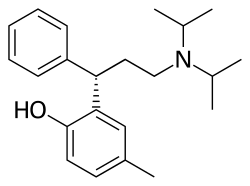 |
|
| Trade names | Detrol, Detrusitol, others |
|---|
| Other names | PNU-200583E |
|---|
| AHFS/Drugs.com | Monograph |
|---|
| MedlinePlus | a699026 |
|---|
| License data |
|
|---|
Pregnancy
category | |
|---|
Routes of
administration | By mouth |
|---|
| ATC code | |
|---|
|
| Legal status |
- AU: S4 (Prescription only)
- CA: ℞-only
- UK: POM (Prescription only)[1]
- US: ℞-only[2][3]
- EU: Rx-only[4]
|
|---|
|
| Bioavailability | 77% |
|---|
| Protein binding | Approximately 96.3% |
|---|
| Elimination half-life | 1.9–3.7 hours |
|---|
|
(S)-2-[3-(Diisopropylamino)-1-phenylpropyl]-4-methylphenol
|
| CAS Number | |
|---|
| PubChem CID | |
|---|
| IUPHAR/BPS | |
|---|
| DrugBank | |
|---|
| ChemSpider | |
|---|
| UNII | |
|---|
| KEGG | |
|---|
| ChEBI | |
|---|
| ChEMBL | |
|---|
| CompTox Dashboard (EPA) | |
|---|
| ECHA InfoCard | 100.232.068 |
|---|
|
| Formula | C22H31NO |
|---|
| Molar mass | 325.496 g·mol−1 |
|---|
| 3D model (JSmol) | |
|---|
Cc1ccc(c(c1)[C@H](CCN(C(C)C)C(C)C)c2ccccc2)O
|
InChI=1S/C22H31NO/c1-16(2)23(17(3)4)14-13-20(19-9-7-6-8-10-19)21-15-18(5)11-12-22(21)24/h6-12,15-17,20,24H,13-14H2,1-5H3/t20-/m1/s1  Y YKey:OOGJQPCLVADCPB-HXUWFJFHSA-N Y
|
| (verify) |
Tolterodine, sold under the brand name Detrol among others, is a medication used to treat frequent urination, urinary incontinence, or urinary urgency.[5] Effects are seen within an hour.[6] It is taken by mouth.[6][7]
Common side effects include headache, dry mouth, constipation, and dizziness.[6] Serious side effects may include angioedema, urinary retention, and QT prolongation.[6] Use in pregnancy and breastfeeding are of unclear safety.[5][8] It works by blocking muscarinic receptors in the bladder thus decreasing bladder contractions.[6]
Tolterodine was approved for medical use in 1998.[6] It is available as a generic medication.[5] In 2020, it was the 271st most commonly prescribed medication in the United States, with more than 1 million prescriptions.[9][10]
Medical uses
Detrusor overactivity (DO, contraction of the muscular bladder wall) is the most common form of urinary incontinence (UI) in older adults. It is characterized by uninhibited bladder contractions causing an uncontrollable urge to void. Urinary frequency, urge incontinence and nocturnal incontinence occur. Abnormal bladder contractions that coincide with the urge to void can be measured by urodynamic studies. Treatment is bladder retraining,[11] pelvic floor therapy or with drugs that inhibit bladder contractions such as oxybutynin and tolterodine.
Side effects
Known side effects:
- Dry mouth[12]
- Decreased gastric motility (upset stomach)[12]
- Headache[12]
- Constipation[12]
- Dry eyes[12]
- Sleepiness[12]
- Urinary retention[12]
The following reactions have been reported in people who have taken tolterodine since it has become available:
- Allergic reactions including swelling[12]
- Rapid heartbeat or abnormal heartbeat[12]
- Accumulation of fluid in the arms and legs[12]
Tolterodine is not recommended for use in people with myasthenia gravis and angle closure glaucoma.
Pharmacology
Tolterodine acts on M2 and M3[13] subtypes of muscarinic receptors whereas older antimuscarinic treatments for overactive bladder act more specifically on M3 receptors.
Tolterodine, although it acts on all types of receptors, has fewer side effects than oxybutynin (M3 and M1 selective, but more so in the parotid than in the bladder) as tolterodine targets the bladder more than other areas of the body.
Society and culture
Brand names
It is marketed by Pfizer in Canada and the United States under the brand name Detrol, while in Indonesia it is marketed under the brand name Detrusitol. In Egypt it is also found under the trade names Tolterodine by Sabaa and Incont L.A. by Adwia.
In the US, Detrol is marketed by Viatris after Upjohn was spun off from Pfizer.[14][15][16]
References
Urologicals, including antispasmodics (G04B) |
|---|
| Acidifiers | |
|---|
Urinary antispasmodics
(primarily antimuscarinics) | |
|---|
| Other urologicals | |
|---|
Hallucinogens |
|---|
Psychedelics
(5-HT2A agonists) |
- Tryptamines (e.g., DMT, psilocin, psilocybin, bufotenin, 5-MeO-DMT, AMT)
- Phenethylamines (e.g., mescaline, 2C-B, DOM, MDA, TMA, 2C-B-FLY, 25I-NBOMe)
- Lysergamides (e.g., LSD, ergine, isoergine)
- Others (e.g., efavirenz, IHCH-7113, MK-212, quipazine, RH-34)
- For a full list of serotonergic psychedelics, see the navbox here and the list here instead.
|
|---|
Dissociatives
(NMDA antagonists) |
- Arylcyclohexylamines (e.g., ketamine (K), phencyclidine (PCP), methoxetamine (MXE), tiletamine)
- Adamantanes (e.g., memantine, amantadine)
- Diarylethylamines (e.g., diphenidine, ephenidine, methoxphenidine)
- Morphinans (e.g., dextromethorphan (DXM), dextrorphan (DXO))
- Inhalants (e.g., nitrous oxide (N2O), xenon (Xe))
- Others (e.g., alkyl nitrites/poppers, aptiganel, dexoxadrol, dizocilpine (MK-801), etoxadrol, selfotel)
- For a full list of dissociatives, see the navbox here instead.
|
|---|
Deliriants
(mACh antagonists) | |
|---|
| KOR agonists |
- Salvinoids (terpenoids): 2-EMSB
- 2-MMSB
- RB-64 (22-thiocyanatosalvinorin A)
- Salvinorin A
- Arylacetamides: Enadoline
- LPK-26
- Niravoline
- Spiradoline
- U-50488
- U-69593
|
|---|
| GABAA agonists |
- Indirect GABAA receptor agonists: GABAA receptor positive allosteric modulators (nonbenzodiazepines/Z-drugs) (e.g., eszopiclone, zaleplon, zolpidem, zopiclone)
- GABA reuptake inhibitors (e.g., CI-966)
|
|---|
Oneirogens
(unknown mech.) |
- Harmala alkaloids/β-carbolines (e.g., harmine, harmaline, tetrahydroharmine, 6-methoxyharmalan, 6-MeO-THH) (found in Peganum harmala, Banisteriopsis caapi)
- Iboga alkaloids/azepinoindoles (e.g., ibogaine, noribogaine) (found in Tabernanthe iboga)
|
|---|
Cannabinoids
(CB1 agonists) |
- For a full list of cannabinoids, see the navbox here and the list here instead.
|
|---|
| Others |
- Aminochromes (e.g., adrenochrome, adrenolutin)
- Carbogen
- Glaucine
- Hallucinogenic bolete mushrooms (e.g., Lanmaoa asiatica)
- Jenkem
- Kykeon (Eleusinian Mysteries)
- Nutmeg (e.g., myristicin, elemicin)
- Soma (haoma)
|
|---|
- See also: Psychedelics
- Dissociatives
- Entactogens
- Stimulants
- Depressants
- List of hallucinogens
|
Muscarinic acetylcholine receptor modulators |
|---|
| mAChRsTooltip Muscarinic acetylcholine receptors | | Agonists |
- 77-LH-28-1
- AC-42
- AC-260,584
- Aceclidine
- Acetylcholine
- AF30
- AF150(S)
- AF267B
- Alvameline
- AQRA-741
- Arecoline
- Bethanechol
- Butyrylcholine
- Carbachol
- CDD-0034
- CDD-0078
- CDD-0097
- CDD-0098
- CDD-0102
- Cevimeline
- Choline
- cis-Dioxolane
- Desmethylclozapine (norclozapine)
- Ethoxysebacylcholine
- Guvacoline
- Itameline
- LY-593,039
- L-689,660
- LY-2,033,298
- McNA343
- Methacholine
- Milameline
- Muscarine
- NGX-267
- Ocvimeline
- Oxotremorine
- PD-151,832
- Pilocarpine
- RS86
- Sabcomeline
- SDZ 210-086
- Sebacylcholine
- Suberyldicholine
- Talsaclidine
- Tazomeline
- Thiopilocarpine
- Vedaclidine
- VU-0029767
- VU-0090157
- VU-0152099
- VU-0152100
- VU-0238429
- WAY-132,983
- Xanomeline
- YM-796
|
|---|
| Antagonists |
- 3-Quinuclidinyl benzilate
- 4-DAMP
- Aclidinium bromide (+formoterol)
- Abediterol
- AF-DX 250
- AF-DX 384
- Ambutonium bromide
- Anisodamine
- Anisodine
- Antihistamines (first-generation) (e.g., brompheniramine, buclizine, captodiame, chlorphenamine (chlorpheniramine), cinnarizine, clemastine, cyproheptadine, dimenhydrinate, dimetindene, diphenhydramine, doxylamine, meclizine, mequitazine, perlapine, phenindamine, pheniramine, phenyltoloxamine, promethazine, propiomazine, triprolidine)
- AQ-RA 741
- Atropine
- Atropine methonitrate
- Atypical antipsychotics (e.g., clozapine, fluperlapine, olanzapine (+fluoxetine), rilapine, quetiapine, tenilapine, zotepine)
- Benactyzine
- Benzatropine (benztropine)
- Benzilone
- Benzilylcholine mustard
- Benzydamine
- Bevonium
- BIBN 99
- Biperiden
- Bornaprine
- Camylofin
- CAR-226,086
- CAR-301,060
- CAR-302,196
- CAR-302,282
- CAR-302,368
- CAR-302,537
- CAR-302,668
- Caramiphen
- Cimetropium bromide
- Clidinium bromide
- Cloperastine
- CS-27349
- Cyclobenzaprine
- Cyclopentolate
- Darifenacin
- DAU-5884
- Desfesoterodine
- Dexetimide
- DIBD
- Dicycloverine (dicyclomine)
- Dihexyverine
- Difemerine
- Diphemanil metilsulfate
- Ditran
- Drofenine
- EA-3167
- EA-3443
- EA-3580
- EA-3834
- Emepronium bromide
- Etanautine
- Etybenzatropine (ethybenztropine)
- Fenpiverinium
- Fentonium bromide
- Fesoterodine
- Flavoxate
- Glycopyrronium bromide (+beclometasone/formoterol, +indacaterol, +neostigmine)
- Hexahydrodifenidol
- Hexahydrosiladifenidol
- Hexbutinol
- Hexocyclium
- Himbacine
- HL-031,120
- Homatropine
- Imidafenacin
- Ipratropium bromide (+salbutamol)
- Isopropamide
- J-104,129
- Hyoscyamine
- Mamba toxin 3
- Mamba toxin 7
- Mazaticol
- Mebeverine
- Meladrazine
- Mepenzolate
- Methantheline
- Methoctramine
- Methylatropine
- Methylhomatropine
- Methylscopolamine
- Metixene
- Muscarinic toxin 7
- N-Ethyl-3-piperidyl benzilate
- N-Methyl-3-piperidyl benzilate
- Nefopam
- Octatropine methylbromide (anisotropine methylbromide)
- Orphenadrine
- Otenzepad (AF-DX 116)
- Otilonium bromide
- Oxapium iodide
- Oxitropium bromide
- Oxybutynin
- Oxyphencyclimine
- Oxyphenonium bromide
- PBID
- PD-102,807
- PD-0298029
- Penthienate
- Pethidine
- pFHHSiD
- Phenglutarimide
- Phenyltoloxamine
- Pipenzolate bromide
- Piperidolate
- Pirenzepine
- Piroheptine
- Pizotifen
- Poldine
- Pridinol
- Prifinium bromide
- Procyclidine
- Profenamine (ethopropazine)
- Propantheline bromide
- Propiverine
- Quinidine
- 3-Quinuclidinyl thiochromane-4-carboxylate
- Revefenacin
- Rociverine
- RU-47,213
- SCH-57,790
- SCH-72,788
- SCH-217,443
- Scopolamine (hyoscine)
- Scopolamine butylbromide (hyoscine butylbromide)
- Silahexacyclium
- Sofpironium bromide
- Solifenacin
- SSRIsTooltip Selective serotonin reuptake inhibitors (e.g., femoxetine, paroxetine)
- Telenzepine
- Terodiline
- Tetracyclic antidepressants (e.g., amoxapine, maprotiline, mianserin, mirtazapine)
- Tiemonium iodide
- Timepidium bromide
- Tiotropium bromide
- Tiquizium bromide
- Tofenacin
- Tolterodine
- Tricyclic antidepressants (e.g., amitriptyline (+perphenazine), amitriptylinoxide, butriptyline, cidoxepin, clomipramine, desipramine, desmethyldesipramine, dibenzepin, dosulepin (dothiepin), doxepin, imipramine, lofepramine, nitroxazepine, northiaden (desmethyldosulepin), nortriptyline, protriptyline, quinupramine, trimipramine)
- Tridihexethyl
- Trihexyphenidyl
- Trimebutine
- Tripitamine (tripitramine)
- Tropacine
- Tropatepine
- Tropicamide
- Tropine benzilate
- Trospium chloride
- Typical antipsychotics (e.g., chlorpromazine, chlorprothixene, cyamemazine (cyamepromazine), loxapine, mesoridazine, thioridazine)
- Umeclidinium bromide (+vilanterol)
- WIN-2299
- Xanomeline
- Zamifenacin
|
|---|
|
|---|
Precursors
(and prodrugs) | |
|---|
- See also
- Receptor/signaling modulators
- Nicotinic acetylcholine receptor modulators
- Acetylcholine metabolism/transport modulators
|