Silver oxide
 | |||
| |||
| Names | |||
|---|---|---|---|
| IUPAC name
Silver(I) oxide
| |||
| Other names
Silver rust, Argentous oxide, Silver monoxide
| |||
| Identifiers | |||
CAS Number
|
|||
3D model (JSmol)
|
|||
| ChemSpider | |||
| ECHA InfoCard | 100.039.946 | ||
| EC Number |
| ||
| MeSH | silver+oxide | ||
PubChem CID
|
|||
| RTECS number |
| ||
| UNII | |||
CompTox Dashboard (EPA)
|
|||
InChI
| |||
SMILES
| |||
| Properties | |||
Chemical formula
|
Ag2O | ||
| Molar mass | 231.735 g·mol−1 | ||
| Appearance | Black/brown cubic crystals | ||
| Odor | Odorless[1] | ||
| Density | 7.14 g/cm3 | ||
| Melting point | decomposes from ≥350 °C[5] | ||
Solubility in water
|
0.013 g/L (20 °C) 0.025 g/L (25 °C)[2] 0.053 g/L (80 °C)[3] | ||
Solubility product (Ksp) of AgOH
|
1.52·10−8 (20 °C) | ||
| Solubility | Soluble in acid, alkali Insoluble in ethanol[2] | ||
| Acidity (pKa) | 12.1 (estimated)[4] | ||
Magnetic susceptibility (χ)
|
−134.0·10−6 cm3/mol | ||
| Structure | |||
Crystal structure
|
Cubic | ||
Space group
|
Pn3m, 224 | ||
| Thermochemistry | |||
Heat capacity (C)
|
65.9 J/mol·K[2] | ||
Std molar
entropy (S⦵298) |
122 J/mol·K[6] | ||
Std enthalpy of
formation (ΔfH⦵298) |
−31 kJ/mol[6] | ||
Gibbs free energy (ΔfG⦵)
|
−11.3 kJ/mol[7] | ||
| Hazards | |||
| GHS labelling: | |||
Pictograms
|
  [8] [8]
| ||
Signal word
|
Danger | ||
Hazard statements
|
H272, H315, H319, H335[8] | ||
Precautionary statements
|
P220, P261, P305+P351+P338[8] | ||
| NFPA 704 (fire diamond) | 
2
0
1 | ||
| Lethal dose or concentration (LD, LC): | |||
LD50 (median dose)
|
2.82 g/kg (rats, oral)[1] | ||
| Related compounds | |||
Related compounds
|
Silver(I,III) oxide | ||
Except where otherwise noted, data are given for materials in their standard state (at 25 °C [77 °F], 100 kPa).
Infobox references
| |||
-oxide-unit-cell-3D-bs-17.png)
-oxide-xtal-3x3x3-3D-bs-17.png)


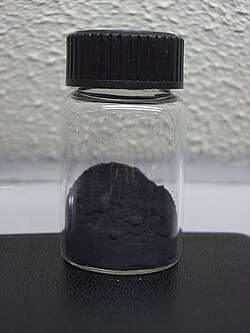
Silver oxide is the chemical compound with the formula Ag2O. It is a fine black or dark brown powder that is used to prepare other silver compounds.
Preparation
_oxide.JPG)
Silver oxide can be prepared by combining aqueous solutions of silver nitrate and an alkali hydroxide.[9][10] This reaction does not afford appreciable amounts of silver hydroxide due to the favorable energetics for the following reaction:[11]
- 2 AgOH → Ag2O + H2O (pK = 2.875[12])
With suitably controlled conditions, this reaction can be used to prepare Ag2O powder with properties suitable for several uses including as a fine grained conductive paste filler.[13]
Structure and properties
Ag2O features linear, two-coordinate Ag centers linked by tetrahedral oxides. It is isostructural with Cu2O. It "dissolves" in solvents that degrade it. It is slightly soluble in water due to the formation of the ion Ag(OH)−2 and possibly related hydrolysis products.[14] It is soluble in ammonia solution, producing active compound of Tollens' reagent. A slurry of Ag2O is readily attacked by acids:
- Ag2O + 2 HX → 2 AgX + H2O
where HX = HF, HCl, HBr, HI, or CF3COOH. It will also react with solutions of alkali chlorides to precipitate silver chloride, leaving a solution of the corresponding alkali hydroxide.[14][15]
Despite the photosensitivity of many silver compounds, silver oxide is not photosensitive.[16] A significant amount of the oxide reduces to metallic silver at temperatures above 380 °C.[17]
Applications
This oxide is used in silver-oxide batteries.[18] In organic chemistry, silver oxide is used as a mild oxidizing agent.[19] For example, it oxidizes aldehydes to carboxylic acids.[20]
References
- ^ a b c "Silver Oxide MSDS". SaltLakeMetals.com. Salt Lake Metals. Retrieved 2014-06-08.
- ^ a b c Lide, David R. (1998). Handbook of Chemistry and Physics (81 ed.). Boca Raton, FL: CRC Press. pp. 4–83. ISBN 0-8493-0594-2.
- ^ Perry, Dale L. (1995). Handbook of Inorganic Compounds (illustrated ed.). CRC Press. p. 354. ISBN 0849386713.
- ^ Perrin, D. D., ed. (1982) [1969]. Ionisation Constants of Inorganic Acids and Bases in Aqueous Solution. IUPAC Chemical Data (2nd ed.). Oxford: Pergamon (published 1984). Entry 210. ISBN 0-08-029214-3. LCCN 82-16524.
- ^ Herley, P. J.; Prout, E. G. (1960-04-01). "The Thermal Decomposition of Silver Oxide". Journal of the American Chemical Society. 82 (7): 1540–1543. Bibcode:1960JAChS..82.1540H. doi:10.1021/ja01492a006. ISSN 0002-7863.
- ^ a b Zumdahl, Steven S. (2009). Chemical Principles 6th Ed. Houghton Mifflin Company. p. A23. ISBN 978-0-618-94690-7.
- ^ "Silver oxide".
- ^ a b c Sigma-Aldrich Co., Silver(I) oxide. Retrieved on 2014-06-07.
- ^ O. Glemser and H. Sauer "Silver Oxide" in Handbook of Preparative Inorganic Chemistry, 2nd Ed. Edited by G. Brauer, Academic Press, 1963, NY. Vol. 1. p. 1037.
- ^ Janssen, D. E.; Wilson, C. V. (1963). "4-Iodoveratrole". Organic Syntheses
{{cite journal}}: CS1 maint: multiple names: authors list (link); Collected Volumes, vol. 4, p. 547. - ^ Holleman, A. F.; Wiberg, E. "Inorganic Chemistry" Academic Press: San Diego, 2001. ISBN 0-12-352651-5.
- ^ Biedermann, George; Sillén, Lars Gunnar (1960). "Studies on the Hydrolysis of Metal Ions. Part 30. A Critical Survey of the Solubility Equilibria of Ag2O". Acta Chemica Scandinavica. 13: 717–725. doi:10.3891/acta.chem.scand.14-0717.
- ^ US 20050050990A1, Harigae, Kenichi & Shoji, Yoshiyuki, "Fine-grain silver oxide powder", published 2005-03-10
- ^ a b Cotton, F. Albert; Wilkinson, Geoffrey (1966). Advanced Inorganic Chemistry (2nd Ed.). New York:Interscience. p. 1042.
{{cite book}}: CS1 maint: publisher location (link) - ^ General Chemistry by Linus Pauling, 1970 Dover ed. p703-704
- ^ Herley, P. J.; Prout, E. G. (1960-04-01). "The Thermal Decomposition of Silver Oxide". Journal of the American Chemical Society. 82 (7): 1540–1543. Bibcode:1960JAChS..82.1540H. doi:10.1021/ja01492a006. ISSN 0002-7863.
- ^ Alfayez, Fayez; Agrachev, Mikhail; Matter, Fabian; Lehner, Sandro; Sekar, Arvindh; Caseri, Walter; Hufenus, Rudolf; Gaan, Sabyasachi; Heuberger, Manfred P. (2025). "Silver Oxide Reduction Chemistry in an Alkane Environment". ACS Applied Materials & Interfaces. 17 (19): 28808–28821. Bibcode:2025AAMI...1728808A. doi:10.1021/acsami.5c01780. PMC 12086840. PMID 40299314.
- ^ "Duracell PROCELL: The Chemistries: Silver Oxide". 2009-12-20. Archived from the original on 2009-12-20. Retrieved 2024-05-12.
- ^ 裴, 坚 (2017). 基础有机化学 [Basic Organic Chemistry] (in Chinese) (4th ed.). p. 1064.
- ^ Chakraborty, Debashis; Gowda, Ravikumar R.; Malik, Payal (2009). "Silver nitrate-catalyzed oxidation of aldehydes to carboxylic acids by H2O2". Tetrahedron Letters. 50 (47): 6553–6556. doi:10.1016/j.tetlet.2009.09.044.
External links

- Annealing of Silver Oxide – Demonstration experiment: Instruction and video