Disodium hydrogen arsenate
 | |
| Names | |
|---|---|
| IUPAC name
Disodium hydrogen arsorate
| |
| Other names
Sodium arsenate dibasic
| |
| Identifiers | |
CAS Number
|
|
3D model (JSmol)
|
|
| ChEBI | |
| ChemSpider | |
| ECHA InfoCard | 100.029.002 |
| EC Number |
|
PubChem CID
|
|
| UNII | |
| UN number | 1685 |
CompTox Dashboard (EPA)
|
|
InChI
| |
SMILES
| |
| Properties | |
Chemical formula
|
H15Na2AsO11 (heptahydrate) |
| Molar mass | 312.01 g/mol (heptahydrate) |
| Appearance | white solid |
Solubility in water
|
good |
| Hazards | |
| Occupational safety and health (OHS/OSH): | |
Main hazards
|
poison |
| GHS labelling: | |
Pictograms
|
|
Signal word
|
Danger |
Hazard statements
|
H301, H331, H350, H410 |
Precautionary statements
|
P201, P202, P261, P264, P270, P271, P273, P281, P301+P310, P304+P340, P308+P313, P311, P321, P330, P391, P403+P233, P405, P501 |
Except where otherwise noted, data are given for materials in their standard state (at 25 °C [77 °F], 100 kPa).
Infobox references
| |

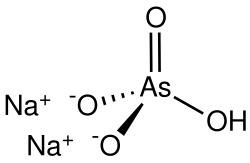
Disodium hydrogen arsenate is the inorganic compound with the formula Na2HAsO4.7H2O. The compound consists of a salt and seven molecules of water of crystallization although for simplicity the formula usually omits the water component. The other sodium arsenates are NaH2AsO4 and Na3AsO4, the latter being called sodium arsenate. Disodium hydrogen arsenate is highly toxic. The salt is the conjugate base of arsenic acid. It is a white, water-soluble solid.[1]
Being a diprotic acid, its acid-base properties is described by two equilibria:
- H
2AsO−
4 + H2O ⇌ HAsO2−
4 + H3O+ (pKa2 = 6.94) - HAsO2−
4 + H2O ⇌ AsO3−
4 + H3O+ (pKa3 = 11.5)
Related compounds
- Monopotassium arsenate, KH2AsO4
References
- ^ Grund, S. C.; Hanusch, K.; Wolf, H. U. "Arsenic and Arsenic Compounds". Ullmann's Encyclopedia of Industrial Chemistry. Weinheim: Wiley-VCH. doi:10.1002/14356007.a03_113.pub2. ISBN 978-3-527-30673-2.