Sodium superoxide
 | |
| Names | |
|---|---|
| IUPAC name
sodium superoxide
| |
| Other names
sodium superoxide
sodium dioxide | |
| Identifiers | |
CAS Number
|
|
3D model (JSmol)
|
|
| ChemSpider | |
| ECHA InfoCard | 100.298.059 |
PubChem CID
|
|
| RTECS number |
|
| UNII | |
| UN number | 2547 |
CompTox Dashboard (EPA)
|
|
InChI
| |
SMILES
| |
| Properties | |
Chemical formula
|
NaO2 |
| Molar mass | 54.9886 g/mol |
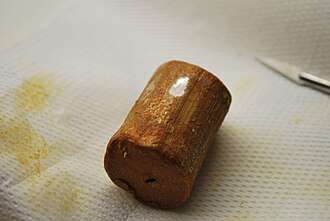
| Appearance | Yellow to orange crystalline solid |
| Density | 2.2 g/cm3 |
| Melting point | 551.7 °C (1,025.1 °F; 824.9 K) |
| Boiling point | Decomposes |
Solubility in water
|
Decomposes |
| Basicity (pKb) | N/A |
| Structure | |
Crystal structure
|
cubic |
| Thermochemistry | |
Heat capacity (C)
|
72.1 J/mol K |
Std molar
entropy (S⦵298) |
115.9 J/mol K |
Std enthalpy of
formation (ΔfH⦵298) |
−260.2 kJ/mol |
Gibbs free energy (ΔfG⦵)
|
−218.4 kJ/mol |
| Hazards | |
| GHS labelling: | |
Pictograms
|
 
|
Signal word
|
Danger |
Hazard statements
|
H271, H314 |
Precautionary statements
|
P210, P220, P260, P280, P303+P361+P353, P305+P351+P338 |
| NFPA 704 (fire diamond) | 
3
0
1 OX |
| Flash point | Non flammable |
| Related compounds | |
Other anions
|
sodium oxide sodium peroxide |
Other cations
|
Lithium superoxide Potassium superoxide Rubidium superoxide Caesium superoxide |
Except where otherwise noted, data are given for materials in their standard state (at 25 °C [77 °F], 100 kPa).
Infobox references
| |


Sodium superoxide is the inorganic compound with the formula NaO2.[1] This yellow-orange solid is a salt of the superoxide anion. It is an intermediate in the oxidation of sodium by oxygen.
Preparation
NaO2 is prepared by treating sodium peroxide with oxygen at high pressures:[2]
- Na2O2 + O2 → 2 NaO2
It can also be prepared by careful oxygenation of a solution of sodium in cryogenic liquid ammonia:
- Na(in NH3) + O2 → NaO2
Although the existence of a sodium oxide higher than peroxide was speculated since 19th century, it was not until 1948 when American chemists were able to definitely synthesize it by the latter method.[3]
Properties
The product is paramagnetic, as expected for a salt of the O−
2 anion. It hydrolyses readily to give a mixture of sodium hydroxide, oxygen and hydrogen peroxide.[4] It crystallizes in the NaCl motif.
References
- ^ Hayyan, Maan; Hashim, Mohd Ali; AlNashef, Inas M. (2016-02-15). "Superoxide Ion: Generation and Chemical Implications". Chemical Reviews. 116 (5). American Chemical Society (ACS): 3029–3085. doi:10.1021/acs.chemrev.5b00407. ISSN 0009-2665. PMID 26875845.
- ^ Stephen E. Stephanou, Edgar J. Seyb Jr., Jacob Kleinberg "Sodium Superoxide" Inorganic Syntheses 1953; Vol. 4, 82-85.
- ^ Schechter, William H.; Sisler, Harry H.; Kleinberg, Jacob (January 1948). "The Absorption of Oxygen by Sodium in Liquid Ammonia: Evidence for the Existence of Sodium Superoxide". Journal of the American Chemical Society. 70 (1): 267–269. doi:10.1021/ja01181a083. ISSN 0002-7863.
- ^ Sasol Encyclopaedia of Science and Technology , G.C. Gerrans, P. Hartmann-Petersen , p.243 "sodium oxides" , google books link