Sodium selenite
 | |
| Identifiers | |
|---|---|
CAS Number
|
|
3D model (JSmol)
|
|
| ChEBI | |
| ChEMBL | |
| ChemSpider | |
| ECHA InfoCard | 100.030.230 |
| EC Number |
|
| KEGG | |
PubChem CID
|
|
| RTECS number |
|
| UNII |
|
| UN number | 2630 |
CompTox Dashboard (EPA)
|
|
InChI
| |
SMILES
| |
| Properties | |
Chemical formula
|
Na2O3Se |
| Molar mass | 172.948 g·mol−1 |
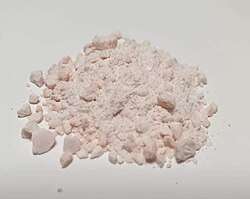
| Appearance | colourless solid |
| Density | 3.1 g/cm3 |
| Melting point | 350 °C (662 °F; 623 K)[2] (decomposes over 300 °C (572 °F; 573 K)) |
Solubility in water
|
89.8 g/100mL (20 °C (68 °F; 293 K))[1] |
| Vapor pressure | < 0.00133 hPa (1.93×10⁻⁵ psi) (20 °C (68 °F; 293 K))[1] |
| Structure[3] | |
Crystal structure
|
|
Space group
|
Pbcm (pentahydrate) |
Lattice constant
|
a = 6.5865 Å, b = 17.2263 Å, c = 14.7778 Å (pentahydrate)
|
Lattice volume (V)
|
1676.70 Å3 (pentahydrate) |
Formula units (Z)
|
8 (pentahydrate) |
| Pharmacology | |
ATC code
|
A12CE02 (WHO) (Oral), B05XA20 (WHO) (Parenteral) |
| Hazards | |
| GHS labelling:[1] | |
Pictograms
|
|
Signal word
|
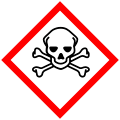
Danger |
Hazard statements
|
H300+H330, H315, H317, H319, H411 |
Precautionary statements
|
P260, P264, P270, P271, P272, P273, P280, P284, P301+P310+P330, P302+P352, P304+P340+P310, P305+P351+P338, P333+P313, P337+P313, P362, P391, P403+P233, P405, P501 |
| NFPA 704 (fire diamond) | 
4
0
0 |
Autoignition
temperature |
> 400 °C (752 °F; 673 K)[1] |
Threshold limit value (TLV)
|
0.2 mg/m3 (as selenium)[4] (TWA) |
| Lethal dose or concentration (LD, LC): | |
LD50 (median dose)
|
7 mg/kg (oral, rat)[2] |
LDLo (lowest published)
|
3.3 mg/kg (oral, sheep)[4] |
| NIOSH (US health exposure limits):[4] | |
PEL (Permissible)
|
0.2 mg/m3 (TWA, as selenium) |
REL (Recommended)
|
0.2 mg/m3 (TWA, as selenium) |
IDLH (Immediate danger)
|
1 mg/m3 |
| Related compounds | |
Other anions
|
|
Other cations
|
|
Except where otherwise noted, data are given for materials in their standard state (at 25 °C [77 °F], 100 kPa).
Infobox references
| |


Sodium selenite is the inorganic compound with the formula Na2SeO3. This salt is a colourless solid. The pink coloured pentahydrate Na2SeO3·5H2O is the most common water-soluble selenium compound.
Synthesis and fundamental reactions
Sodium selenite usually is prepared by the reaction of selenium dioxide with sodium hydroxide:[5]
- SeO2 + 2 NaOH → Na2SeO3 + H2O
The hydrate converts to the anhydrous salt upon heating to 40 °C (104 °F).
According to X-ray crystallography, both anhydrous Na2SeO3 and its pentahydrate feature pyramidal SeO2−3. The Se−O distances range from 1.67 to 1.72 Å.[6] Oxidation of this anion gives sodium selenate, Na2SeO4.[3]
Applications
Together with the related barium and zinc selenites, sodium selenite is mainly used in the manufacture of colorless glass. The pink color imparted by these selenites cancels out the green color imparted by iron impurities.[7]
Because selenium is an essential element, sodium selenite is an ingredient in dietary supplements such as multi-vitamin/mineral products, but supplements that provide only selenium use L-selenomethionine or a selenium-enriched yeast.
The US Food and Drug Administration approved a selenium supplement to animal diets; the most common form is sodium selenite for pet foods. According to one article:
"not much was known about which selenium compounds to approve for use in animal feeds when the decisions were made back in the 1970s .. At the time the regulatory action was taken, only the inorganic selenium salts (sodium selenite and sodium selenate) were available at a cost permitting their use in animal feed."[8]
Sodium selenite has been proposed as an effective suicide agent.[9]
Safety
Selenium is toxic in high concentrations. As sodium selenite, the chronic toxic dose for human beings was described as about 2.4 to 3 mg of selenium per day.[10] In 2000, the US Institute of Medicine set the adult Tolerable upper intake levels (UL) for selenium from all sources - food, drinking water and dietary supplements - at 400 μg/d.[11] The European Food Safety Authority reviewed the same safety question and set its UL at 300 μg/d.[12]
See also
- Selenite (ion)
- Selenous acid
References
- ^ a b c d Sigma-Aldrich Co., Sodium selenite.
- ^ a b c "SDS - Sodium selenite". fishersci.com. ThermoFisher Scientific. 21 December 2025. p. 3. Retrieved 28 January 2026.
- ^ a b Mereiter K (2013). "Sodium Selenite Pentahydrate, Na2SeO3·5H2O". Acta Crystallographica Section E. 69 (11): i77–i78. doi:10.1107/S1600536813028602. PMC 3884237. PMID 24454013.
- ^ a b c "Selenium compounds". Immediately Dangerous to Life or Health Concentrations. National Institute for Occupational Safety and Health.
- ^ Féher F (1963). "7. Sulfur, Selenium, Tellurium - Sodium Selenite". In Brauer G (ed.). Handbook of Preparative Inorganic Chemistry. Vol. 1 (2nd ed.). New York, NY: Academic Press. p. 431-432.
- ^ Wickleder MS (2002). "Sodium Selenite, Na2SeO3". Acta Crystallographica Section E. 58 (11): i103–i104. Bibcode:2002AcCrE..58I.103W. doi:10.1107/S1600536802019384. ISSN 1600-5368.
- ^ Langner BE (2002). "Selenium and Selenium Compounds". Ullmann's Encyclopedia of Industrial Chemistry. Weinheim: Wiley-VCH. doi:10.1002/14356007.a23_525. ISBN 978-3-527-30673-2.
- ^ Schrauzer GN (2001). "Nutritional selenium supplements: product types, quality, and safety". Journal of the American College of Nutrition. 20 (1): 1–4. doi:10.1080/07315724.2001.10719007. PMID 11293463. S2CID 12668227.
- ^ Nitschke P, Stewart F (January 2021). The peaceful pill ehandbook. Bellingham, WA: Exit International. p. 192. ISBN 979-8-7396-5305-5.
- ^ Wilber CG (1980). "Toxicology of selenium". Clinical Toxicology. 17 (2): 171–230. doi:10.3109/15563658008985076. PMID 6998645.
- ^ Institute of Medicine (2000). "Selenium". Dietary Reference Intakes for Vitamin C, Vitamin E, Selenium, and Carotenoids. Washington, DC: The National Academies Press. pp. 284–324. doi:10.17226/9810. ISBN 978-0-309-06935-9. PMID 25077263.
- ^ Tolerable Upper Intake Levels For Vitamins And Minerals (PDF), European Food Safety Authority, 2006