Sodium salicylate
 | |
| Names | |
|---|---|
| Preferred IUPAC name
Sodium 2-hydroxybenzoate | |
Other names
| |
| Identifiers | |
CAS Number
|
|
3D model (JSmol)
|
|
| ChEMBL | |
| ChemSpider | |
| DrugBank | |
| ECHA InfoCard | 100.000.181 |
| EC Number |
|
| KEGG | |
PubChem CID
|
|
| RTECS number |
|
| UNII | |
CompTox Dashboard (EPA)
|
|
InChI
| |
SMILES
| |
| Properties | |
Chemical formula
|
C7H5NaO3 |
| Molar mass | 160.104 g/mol |
| Appearance | White crystals |
| Melting point | 200 °C (392 °F; 473 K) |
Solubility in water
|
25.08 g/100 g (-1.5 °C) 107.9 g/100 g (15 °C) 124.6 g/100 g (25 °C) 141.8 g/100 g (78.5 °C) 179 g/100 g (114 °C)[1] |
| Solubility | Soluble in glycerol, 1,4-Dioxane, alcohol[1] |
| Solubility in methanol | 26.28 g/100 g (15 °C) 34.73 g/100 g (67.2 °C)[1] |
| Pharmacology | |
ATC code
|
N02BA04 (WHO) |
| Hazards | |
| Occupational safety and health (OHS/OSH): | |
Main hazards
|
Harmful |
Eye hazards
|
Irritant |
| GHS labelling:[3] | |
Pictograms
|
|
Signal word
|
Warning |
Hazard statements
|
H314, H331, H400 |
Precautionary statements
|
P210, P261, P273, P280, P305+P351+P338, P310 |
| NFPA 704 (fire diamond) | 
1
1
0 |
Autoignition
temperature |
250 °C (482 °F; 523 K) |
| Lethal dose or concentration (LD, LC): | |
LD50 (median dose)
|
930 mg/kg (rats, oral)[2] |
Except where otherwise noted, data are given for materials in their standard state (at 25 °C [77 °F], 100 kPa).
Infobox references
| |


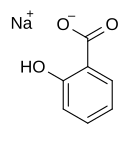
Sodium salicylate is a sodium salt of salicylic acid. It is a shiny white solid, producing mildly alkaline solutions because it can donate one hydrogen-bond and accept three.
Synthesis
Sodium salicylate is industrially prepared via the Kolbe-Schmitt process, by reacting sodium phenoxide with carbon dioxide at around 120 °C and 5 atm in a mixed alcohol solvent containing excess phenol.[4]
![{\displaystyle {\mathrm {C} {\vphantom {A}}_{\smash[{t}]{6}}\mathrm {H} {\vphantom {A}}_{\smash[{t}]{5}}\mathrm {O} {\vphantom {A}}^{-}~\mathrm {Na} {\vphantom {A}}^{+}{}+{}\mathrm {CO} {\vphantom {A}}_{\smash[{t}]{2}}{}\mathrel {\longrightarrow } {}\mathrm {HOC} {\vphantom {A}}_{\smash[{t}]{6}}\mathrm {H} {\vphantom {A}}_{\smash[{t}]{4}}\mathrm {COO} {\vphantom {A}}^{-}~\mathrm {Na} {\vphantom {A}}^{+}}}](./_assets_/eb734a37dd21ce173a46342d1cc64c92/4f54ad6c32e5552db76497609e960c1f609e25af.svg)
This reaction proceeds via a nucleophilic addition-elimination mechanism.[5]
Sodium salicylate can also be prepared by neutralizing salicylic acid with a sodium base such as sodium hydroxide or sodium carbonate[6][7] or by refluxing methyl salicylate with sodium hydroxide.[8]
Uses
Medicine
It is used in medicine as an analgesic and antipyretic.[9] Sodium salicylate also acts as non-steroidal anti-inflammatory drug (NSAID), and induces apoptosis in cancer cells[10][11][12] and also necrosis.[13] It is a potential replacement for aspirin for people sensitive to it.
Sodium salicylate lends its analgesic effects to the inhibition of cyclooxygenase. This enzyme converts arachidonic acid to cyclic endoperoxides, which are precursors to prostaglandins, thus preventing the sensitization of pain receptors.[7]
Sodium salicylate, alongside other salicylates, has historically been used to treat rheumatological disorders.[14][15]
Preservative
Sodium salicylate can be found in cosmetics, personal care products, perfumes, and fragrances, often as a preservative.[16] Among 16 other salicylate salts in these products, it has been concluded to be safe.[17]
Other
It may also be used as a phosphor for the detection of vacuum ultraviolet radiation and beta radiation.[18][19]
References
- ^ a b c "sodium salicylate". chemister.ru. Archived from the original on 24 May 2014. Retrieved 8 April 2018.
- ^ Chambers, Michael. "ChemIDplus - 54-21-7 - ABBQHOQBGMUPJH-UHFFFAOYSA-M - Sodium salicylate [USP:JAN] - Similar structures search, synonyms, formulas, resource links, and other chemical information". chem.sis.nlm.nih.gov. Archived from the original on 9 April 2018. Retrieved 8 April 2018.
- ^ Sigma-Aldrich Co., Sodium salicylate. Retrieved on 2014-05-26.
- ^ EP0072095B1, Jansen, Gert & Wolff, Per, "Production of sodium salicylate", issued 1986-05-21
- ^ Kojčinović, Aleksa; Likozar, Blaž; Grilc, Miha (2024-12-01). "Mechanism, Kinetics and Modelling of Phenol Carboxylation Reactions with CO2". International Journal of Molecular Sciences. 25 (23) 12923. doi:10.3390/ijms252312923. ISSN 1422-0067. PMC 11640782. PMID 39684634.
- ^ PubChem. "Salicylic Acid". pubchem.ncbi.nlm.nih.gov. Retrieved 2025-08-08.
- ^ a b PubChem. "Sodium Salicylate". pubchem.ncbi.nlm.nih.gov. Retrieved 2025-08-08.
- ^ Lehman, J.W., Operational Organich Chemistry, 4th ed., New Jersey, Prentice Hall, 2009
- ^ "Sodium salicylate | 54-21-7". ChemicalBook. Archived from the original on 2024-09-02. Retrieved 2024-09-02.
- ^ Klampfer, Lidija; Jörg Cammenga; Hans-Georg Wisniewski; Stephen D. Nimer (1999-04-01). "Sodium Salicylate Activates Caspases and Induces Apoptosis of Myeloid Leukemia Cell Lines". Blood. 93 (7): 2386–94. doi:10.1182/blood.V93.7.2386. PMID 10090950.
- ^ Rae, Colin; Susana Langa; Steven J. Tucker; David J. MacEwan (2007-07-31). "Elevated NF-κB responses and FLIP levels in leukemic but not normal lymphocytes: reduction by salicylate allows TNF-induced apoptosis". Proceedings of the National Academy of Sciences of the USA. 104 (31): 12790–5. Bibcode:2007PNAS..10412790R. doi:10.1073/pnas.0701437104. PMC 1937545. PMID 17646662.
- ^ Stark, Lesley A.; et al. (May 2007). "Aspirin activates the NF-κB signalling pathway and induces apoptosis in intestinal neoplasia in two in vivo models of human colorectal cancer". Carcinogenesis. 28 (5): 968–76. doi:10.1093/carcin/bgl220. PMID 17132819.
- ^ Schwenger, Paul; Edward Y. Skolnik; Jan Vilcek (1996-04-05). "Inhibition of Tumor Necrosis Factor-induced p42/p44 Mitogen-Activated Protein Kinase Activation by Sodium Salicylate". The Journal of Biological Chemistry. 271 (14): 8089–94. doi:10.1074/jbc.271.14.8089. PMID 8626494.
- ^ Hedner, T.; Everts, B. (1998). "The early clinical history of salicylates in rheumatology and pain". Clinical Rheumatology. 17 (1): 17–25. doi:10.1007/BF01450953. ISSN 0770-3198. PMID 9586674.
- ^ "Sodium salicylate, 99% | Thermo Scientific Alfa Aesar | Fisher Scientific". www.fishersci.co.uk. Retrieved 2025-12-22.
- ^ PubChem. "Sodium Salicylate". pubchem.ncbi.nlm.nih.gov. Retrieved 2025-12-22.
- ^ Johnson, Wilbur; Zhu, Jinqiu; Bergfeld, Wilma F.; Belsito, Donald V.; Hill, Ronald A.; Klaassen, Curtis D.; Liebler, Daniel C.; Marks, James G.; Shank, Ronald C.; Slaga, Thomas J.; Snyder, Paul W.; Fiume, Monice M.; Heldreth, Bart (2025). "Amended Safety Assessment of Salicylic Acid and Salicylates as Used in Cosmetics". International Journal of Toxicology. 44 (4_suppl): 5S–57S. doi:10.1177/10915818251389456. ISSN 1092-874X. PMID 41243163.
- ^ Samson, James. "Vacuum Ultraviolet Spectroscopy" (PDF). Pied Publications. Archived from the original (PDF) on October 16, 2006. Retrieved July 26, 2012.
- ^ Chamberlain, John P. (1979-09-15). "Fluorographic detection of radioactivity in polyacrylamide gols with the water-soluble fluor, sodium salicylate". Analytical Biochemistry. 98 (1): 132–135. doi:10.1016/0003-2697(79)90716-4. hdl:2027.42/23492. ISSN 0003-2697.
External links

- Chemicalland21
- Some synonyms
- Safety data for sodium salicylate at Oxford University Archived 2006-05-23 at the Wayback Machine
- Sodium salicylate, definitions at National Cancer Institute
Nonsteroidal anti-inflammatory drugs (NSAIDs) (primarily M01A and M02A, also N02BA) | |
|---|---|
| pyrazolones / pyrazolidines |
|
| salicylates |
|
| acetic acid derivatives and related substances |
|
| oxicams | |
| propionic acid derivatives (profens) |
|
| n-arylanthranilic acids (fenamates) |
|
| COX-2 inhibitors (coxibs) |
|
| other |
|
| NSAID combinations |
|
Key: underline indicates initially developed first-in-class compound of specific group; #WHO-Essential Medicines; †withdrawn drugs; ‡veterinary use. | |
| |

