Sodium percarbonate
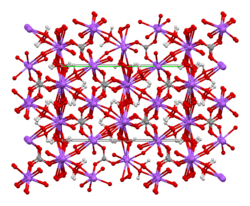 Crystal structure at 100 K [1]
| |
| Names | |
|---|---|
| IUPAC name
sodium carbonate—hydrogen peroxide (2/3)
| |
Other names
| |
| Identifiers | |
CAS Number
|
|
3D model (JSmol)
|
|
| ChemSpider | |
| ECHA InfoCard | 100.036.082 |
| EC Number |
|
PubChem CID
|
|
| RTECS number |
|
| UNII | |
| UN number | 3378 |
CompTox Dashboard (EPA)
|
|
InChI
| |
SMILES
| |
| Properties | |
Chemical formula
|
2 Na2CO3 · 3 H2O2 |
| Molar mass | 157.009 g·mol−1 |
| Appearance | White solid |
| Density | 2.01 g/cm3 at 20.4 °C (68.7 °F)[2] |
Solubility in water
|
150 g/L at 20 °C (68 °F)[2] |
| Hazards[2] | |
| GHS labelling: | |
Pictograms
|
  
|
Signal word
|
Danger |
Hazard statements
|
H272, H302, H318, H401 |
Precautionary statements
|
P210, P220, P264, P280, P301+P312+P330, P305+P351+P338+P310, P370+P378, P501 |
| NFPA 704 (fire diamond) | 
2
0
0 OX |
| Lethal dose or concentration (LD, LC): | |
LD50 (median dose)
|
|
| Related compounds | |
Other anions
|
|
Related compounds
|
|
Except where otherwise noted, data are given for materials in their standard state (at 25 °C [77 °F], 100 kPa).
Infobox references
| |

Sodium percarbonate or sodium carbonate peroxide is an inorganic compound with the formula 2 Na2CO3 · 3 H2O2. It is an addition compound, specifically a co-crystal, formed by sodium carbonate ("soda ash" or "washing soda") and hydrogen peroxide (that is, a perhydrate). It is a colorless, crystalline, hygroscopic, and water-soluble solid.[4] It is sometimes abbreviated as SPC. It contains 32.5% by weight of hydrogen peroxide.
The product is used in some eco-friendly bleaches and other cleaning products.[4]
History
Sodium percarbonate was first prepared in 1899 by the Russian chemist Sebastian Moiseevich Tanatar (7 October 1849 – 30 November 1917).[5]
Structure
At room temperature, solid sodium percarbonate has the orthorhombic crystal structure, with the Cmca crystallographic space group. The structure changes to Pbca as the crystals are cooled below about −30 °C (−22 °F).[1]
Chemistry
Dissolved in water, sodium percarbonate yields a mixture of hydrogen peroxide, sodium cations (Na+), and carbonate (CO2−3).[4][6]
![{\displaystyle {2\,\mathrm {Na} {\vphantom {A}}_{\smash[{t}]{2}}\mathrm {CO} {\vphantom {A}}_{\smash[{t}]{3}}\,{\cdot }\,3\,\mathrm {H} {\vphantom {A}}_{\smash[{t}]{2}}\mathrm {O} {\vphantom {A}}_{\smash[{t}]{2}}{}\mathrel {\longrightarrow } {}3\,\mathrm {H} {\vphantom {A}}_{\smash[{t}]{2}}\mathrm {O} {\vphantom {A}}_{\smash[{t}]{2}}{}+{}4\,\mathrm {Na} {\vphantom {A}}^{+}{}+{}2\,\mathrm {CO} {\vphantom {A}}_{\smash[{t}]{3}}{\vphantom {A}}^{2-}}}](./_assets_/eb734a37dd21ce173a46342d1cc64c92/68231c93dcf22ce50cea964c81ea59bb0e1de10c.svg)
Production
Sodium percarbonate is produced industrially by crystallization of a solution of sodium carbonate and hydrogen peroxide, with attention to the pH and concentrations.[7][1] This method is also convenient for the laboratory preparation. Alternatively, dry sodium carbonate may be treated directly with concentrated hydrogen peroxide solution.
World production capacity of this compound was estimated at several hundred thousand tons for 2004.[8]
Uses
As an oxidizing agent, sodium percarbonate is an ingredient in a number of home and laundry cleaning products, including non-chlorine bleach products such as Oxyper, OxiClean, Tide laundry detergent,[4] and Vanish.[6]
Many commercial products mix a percentage of sodium percarbonate with sodium carbonate. The average "Oxy" product in the supermarket contains 35–40% sodium percarbonate with about 5% active oxygen when titrated.
Sodium percarbonate is also used as a cleaning agent in homebrewing.[9]
Sodium percarbonate can be used in organic synthesis as a convenient source of anhydrous H2O2, in particular in solvents that cannot dissolve the carbonate but can leach the H2O2 out of it.[10] A method for generating trifluoroperacetic acid in situ for use in Baeyer–Villiger oxidations from sodium percarbonate and trifluoroacetic anhydride has been reported; it provides a convenient and cheap approach to this reagent without the need to obtain highly concentrated hydrogen peroxide.[11][12]
References
- ^ a b c Pritchard, R.G.; Islam, E. (2003). "Sodium percarbonate between 293 and 100 K". Acta Crystallographica Section B. B59 (5): 596–605. doi:10.1107/S0108768103012291. PMID 14586079.
- ^ a b c Sigma-Aldrich Co., Sodium percarbonate.
- ^ "SDS - Sodium percarbonate". fishersci.com. Thermo-Fisher Scientific. 26 March 2024. p. 3. Retrieved 17 October 2025.
- ^ a b c d Craig W. Jones (1999). Applications of Hydrogen Peroxide and Derivatives. Royal Society of Chemistry. ISBN 0-85404-536-8.
- ^ Tanatar, S. (1899). "Percarbonate". Berichte der Deutschen Chemischen Gesellschaft zu Berlin (in German). 32 (2): 1544–1546. doi:10.1002/cber.18990320233.
- ^ a b "Oxygen-based bleaches", The Royal Society of Chemistry, and Reckitt Benckiser (the manufacturers of Vanish).
- ^ Adams, J. M.; Pritchard, R. G. (1 December 1977). "The crystal structure of sodium percarbonate: an unusual layered solid". Acta Crystallographica Section B Structural Crystallography and Crystal Chemistry. 33 (12): 3650–3653. doi:10.1107/S0567740877011790.
- ^ Jakob, H.; Leininger, S.; Lehmann, T.; Jacobi, S.; Gutewort, S. "Peroxo Compounds, Inorganic". Ullmann's Encyclopedia of Industrial Chemistry. Weinheim: Wiley-VCH. doi:10.1002/14356007.a19_177.pub2. ISBN 978-3-527-30673-2.
- ^ "Sodium Percarbonate". MoreBeer.com. Archived from the original on 3 December 2021. Retrieved 26 June 2020.
- ^ McKillop, A (1995). "Sodium perborate and sodium percarbonate: Cheap, safe and versatile oxidising agents for organic synthesis". Tetrahedron. 51 (22): 6145–6166. doi:10.1016/0040-4020(95)00304-Q.
- ^ Gang, Ho Jeong; Jeong, Hui Seon (January 1996). "New Method of Generating Trifluoroperoxy-acetic acid for the Baeyer-Villiger Reaction" (PDF). Bulletin of the Korean Chemical Society. 17 (1): 5–6. doi:10.5012/bkcs.1996.17.1.5. ISSN 1229-5949.
- ^ Caster, Kenneth C.; Rao, A. Somasekar; Mohan, H. Rama; McGrath, Nicholas A.; Brichacek, Matthew (2012). "Trifluoroperacetic Acid". Encyclopedia of Reagents for Organic Synthesis. e-EROS Encyclopedia of Reagents for Organic Synthesis. doi:10.1002/047084289X.rt254.pub2. ISBN 978-0471936237.