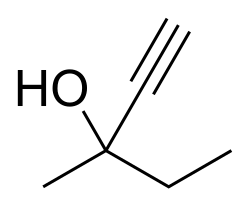
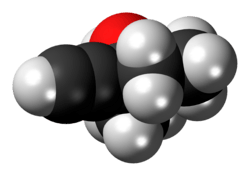
Methylpentynol (also known as methylparafynol, trade names Dormison, Atemorin, Oblivon) is a tertiary pentynol with hypnotic/sedative and anticonvulsant effects and an exceptionally low therapeutic index. It was discovered by Bayer in 1913[2] and was used shortly thereafter for the treatment of insomnia, but its use was quickly phased out in response to newer drugs with far more favorable safety profiles.[3][4][5]
The drug was marketed again in the United States, Europe and elsewhere from 1956 well into the 1960s as a rapid-acting sedative.[6] The drug was quickly overshadowed at that point by benzodiazepines and is no longer sold anywhere.[7]
Synthesis
Methylpentynol is prepared by reaction of butanone (MEK) with sodium acetylide in liquid ammonia. This reaction must be done in anhydrous conditions and in an inert atmosphere.
Applications
As building block in the synthesis of:
- Phthalofyne (1,2-Benzenedicarboxylic acid, mono(1-ethyl-1-methyl-2-propynyl) ester) [131-67-9]
- Anansiol (1-ethyl-1-methylprop-2-ynyl carbamate) [302-66-9]
- Bason ( 2-Bromoethynyl-2-butanol) [2028-52-6]
See also
References
- ^ Anvisa (2023-03-31). "RDC Nº 784 - Listas de Substâncias Entorpecentes, Psicotrópicas, Precursoras e Outras sob Controle Especial" [Collegiate Board Resolution No. 784 - Lists of Narcotic, Psychotropic, Precursor, and Other Substances under Special Control] (in Brazilian Portuguese). Diário Oficial da União (published 2023-04-04). Archived from the original on 2023-08-03. Retrieved 2023-08-16.
- ^ DE patent 289800, "Verfahren zur Darstellung der Oxyalkylderivate von Kohlenwasserstoffen", issued 1913-11-30, assigned to Bayer, Leverkusen
- ^ Hirsh HL, Orsinger WH (January 1952). "Methylparafynol--a new type hypnotic. Preliminary report on its therapeutic efficacy and toxicity". American Practitioner and Digest of Treatment. 3 (1): 23–6. PMID 14903452.
- ^ Schaffarzick RW, Brown BJ (December 1952). "The anticonvulsant activity and toxicity of methylparafynol (dormison) and some other alcohols". Science. 116 (3024): 663–5. Bibcode:1952Sci...116..663S. doi:10.1126/science.116.3024.663. PMID 13028241.
- ^ Herz A (March 1954). "[A new type of hypnotic; unsaturated tertiary carbinols; experimental studies on therapeutic use of 3-methyl-pentin-ol-3 (methylparafynol)]". Arzneimittel-Forschung. 4 (3): 198–9. PMID 13159700.
- ^ Weaver LC, Alexander WM, Abreu BE (April 1961). "Anticonvulsant activity of compounds related to methylparafynol". Archives Internationales de Pharmacodynamie et de Therapie. 131: 116–22. PMID 13783544.
- ^ Hines RD (2002). The Pursuit of Oblivion. p. 327.
- ^ DE 959485, Grimene W, Emde H, issued 1957
Alcohols |
|---|
| By consumption | Alcohols found in
alcoholic drinks | |
|---|
| Medical alcohol | |
|---|
| Toxic alcohols | |
|---|
|
|---|
Primary
alcohols (1°) | | Methanol |
- 4-Methylcyclohexanemethanol
- Aminomethanol
- Cyclohexylmethanol
- Methoxymethanol
- Methylazoxymethanol
- Trifluoromethanol
|
|---|
| Ethanol | |
|---|
| Butanol | |
|---|
Straight-chain
saturated
C1 — C9 | |
|---|
Straight-chain
saturated
C10 — C19 | |
|---|
Straight-chain
saturated
C20 — C29 | |
|---|
Straight-chain
saturated
C30 — C39 |
- 1-Triacontanol (melissyl / myricyl)
- 1-Hentriacontanol
- 1-Dotriacontanol (lacceryl)
- 1-Tritriacontanol
- 1-Tetratriacontanol (geddyl)
- 1-Pentatriacontanol
- 1-Hexatriacontanol
- 1-Heptatriacontanol
- 1-Octatriacontanol
- 1-Nonatriacontanol
|
|---|
Straight-chain
saturated
C40 — C49 |
- 1-Tetracontanol
- 1-Hentetracontanol
- 1-Dotetracontanol
- 1-Tritetracontanol
- 1-Tetratetracontanol
- 1-Pentatetracontanol
- 1-Hexatetracontanol
- 1-Heptatetracontanol
- 1-Octatetracontanol
- 1-Nonatetracontanol
|
|---|
|
|---|
Secondary
alcohols (2°) | |
|---|
Tertiary
alcohols (3°) | |
|---|
| Hydric alcohols | |
|---|
| Amyl alcohols | |
|---|
| Aromatic alcohols | |
|---|
Saturated
fatty alcohols | |
|---|
Branched and
unsaturated
fatty alcohols | |
|---|
| Sugar alcohols | | C1 — C7 | |
|---|
Deoxy sugar
alcohols | |
|---|
Cyclic sugar
alcohols | |
|---|
| Glycylglycitols | |
|---|
|
|---|
| Terpene alcohols | Monoterpene
alcohols | |
|---|
Sesquiterpene
alcohols | |
|---|
Diterpene
alcohols | |
|---|
|
|---|
| Dialcohols | |
|---|
| Trialcohols | |
|---|
| Sterols | |
|---|
| Fluoroalcohols | |
|---|
| Preparations |
- Substitution of haloalkane
- Carbonyl reduction
- Ether cleavage
- Hydrolysis of epoxide
- Hydration of alkene
- Ziegler process
|
|---|
| Reactions |
- Deprotonation
- Protonation
- Alcohol oxidation
- Nucleophilic substitution
- Fischer–Speier esterification
- Williamson ether synthesis
- Elimination reaction
- Nucleophilic substitution of carbonyl group
- Friedel-Crafts alkylation
- Nucleophilic conjugate addition
- Transesterification
|
|---|
 Category Category
|
Hypnotics/sedatives (N05C) |
|---|
| GABAA | | Alcohols | |
|---|
| Barbiturates | |
|---|
| Benzodiazepines | |
|---|
| Carbamates | |
|---|
| Imidazoles | |
|---|
| Monoureides |
- Acecarbromal
- Apronal (apronalide)
- Bromisoval
- Capuride
- Carbromal
- Ectylurea
|
|---|
| Neurosteroids | |
|---|
| Nonbenzodiazepines | |
|---|
| Phenols |
- Cipepofol (ciprofol)
- Fospropofol
- Propofol
- Propofol hemisuccinate
|
|---|
| Piperidinediones | |
|---|
| Quinazolinones |
- Afloqualone
- Cloroqualone
- Diproqualone
- Etaqualone
- Mebroqualone
- Mecloqualone
- Methaqualone
- Methylmethaqualone
- Nitromethaqualone
- SL-164
|
|---|
| Others | |
|---|
|
|---|
| GABAB | |
|---|
| H1 | | Antihistamines | |
|---|
| Antidepressants |
- Serotonin antagonists and reuptake inhibitors
- Tricyclic antidepressants
- Tetracyclic antidepressants
|
|---|
| Antipsychotics |
- Typical antipsychotics
- Atypical antipsychotics
|
|---|
|
|---|
| α2-Adrenergic | |
|---|
| 5-HT2A | | Antidepressants |
- Trazodone
- Tricyclic antidepressants
- Tetracyclic antidepressants
|
|---|
| Antipsychotics |
- Typical antipsychotics
- Atypical antipsychotics
|
|---|
| Others | |
|---|
|
|---|
| Melatonin | |
|---|
| Orexin |
- Daridorexant
- Lemborexant
- Suvorexant
|
|---|
| α2δ VDCC | |
|---|
| Others | |
|---|
GABAA receptor positive modulators |
|---|
| Alcohols | |
|---|
| Barbiturates | |
|---|
| Benzodiazepines | |
|---|
| Carbamates |
- Carisbamate
- Carisoprodol
- Clocental
- Cyclarbamate
- Difebarbamate
- Emylcamate
- Ethinamate
- Febarbamate
- Felbamate
- Hexapropymate
- Hydroxyphenamate
- Lorbamate
- Mebutamate
- Meprobamate
- Nisobamate
- Pentabamate
- Phenprobamate
- Procymate
- Styramate
- Tetrabamate
- Tybamate
|
|---|
| Flavonoids | |
|---|
| Imidazoles |
- Etomidate
- Metomidate
- Methoxyetomidate
- Propoxate
- Isopropoxate
- Butomidate
- Iso-butomidate
- Sec-butomidate
- CF2-Etomidate
- CF3-Etomidate
- CF3-Propoxate
- Flutomidate
- 2,6-Dichloro-3-fluoroetomidate
|
|---|
| Kava constituents |
- 10-Methoxyyangonin
- 11-Methoxyyangonin
- 11-Hydroxyyangonin
- Desmethoxyyangonin
- 11-Methoxy-12-hydroxydehydrokavain
- 7,8-Dihydroyangonin
- Kavain
- 5-Hydroxykavain
- 5,6-Dihydroyangonin
- 7,8-Dihydrokavain
- 5,6,7,8-Tetrahydroyangonin
- 5,6-Dehydromethysticin
- Methysticin
- 7,8-Dihydromethysticin
- Yangonin
|
|---|
| Monoureides |
- Acecarbromal
- Apronal (apronalide)
- Bromisoval
- Carbromal
- Capuride
- Ectylurea
|
|---|
| Neuroactive steroids | |
|---|
| Nonbenzodiazepines |
- Imidazopyridines: Alpidem
- DS-1
- Necopidem
- Saripidem
- Zolpidem
- Pyrazolopyrimidines: Divaplon
- Fasiplon
- Indiplon
- Lorediplon
- Ocinaplon
- Panadiplon
- Taniplon
- Zaleplon
- Others: Adipiplon
- AXS-17 (BAER-101, AZD-7325)
- CGS-8216
- CGS-9896
- CGS-13767
- CGS-20625
- CL-218,872
- CP-615,003
- CTP-354
- ELB-139
- GBLD-345
- Imepitoin
- JM-1232
- L-838,417
- Lirequinil (Ro41-3696)
- Miltirone (rosmariquinone)
- NS-2664
- NS-2710
- NS-11394
- Pipequaline
- ROD-188
- RWJ-51204
- SB-205,384
- SX-3228
- TGSC01AA
- TP-003
- TPA-023
- TP-13
- U-89843A
- U-90042
- Viqualine
- Y-23684
|
|---|
| Phenols | |
|---|
| Piperidinediones | |
|---|
| Pyrazolopyridines |
- Cartazolate
- Etazolate
- ICI-190,622
- Tracazolate
|
|---|
| Quinazolinones |
- Afloqualone
- Cloroqualone
- Diproqualone
- Etaqualone
- Mebroqualone
- Mecloqualone
- Methaqualone
- Methylmethaqualone
- Nitromethaqualone
- SL-164
|
|---|
| Volatiles/gases | |
|---|
| Others/unsorted |
- 3-Hydroxybutanal
- α-EMTBL
- AA-29504
- Alogabat
- Avermectins (e.g., ivermectin)
- Bromide compounds (e.g., lithium bromide, potassium bromide, sodium bromide)
- Carbamazepine
- Chloralose
- Chlormezanone
- Clomethiazole
- Darigabat
- DEABL
- Deuterated etifoxine
- Dihydroergolines (e.g., dihydroergocryptine, dihydroergosine, dihydroergotamine, ergoloid (dihydroergotoxine))
- DS2
- Efavirenz
- Etazepine
- Etifoxine
- Fenamates (e.g., flufenamic acid, mefenamic acid, niflumic acid, tolfenamic acid)
- Fluoxetine
- Flupirtine
- Hopantenic acid
- KRM-II-81
- Lanthanum
- Lavender oil
- Lignans (e.g., 4-O-methylhonokiol, honokiol, magnolol, obovatol)
- Loreclezole
- Menthyl isovalerate (validolum)
- Monastrol
- Nicotinic acid
- Nicotinamide
- Org 25,435
- Phenytoin
- Propanidid
- Retigabine (ezogabine)
- Safranal
- Seproxetine
- Stiripentol
- Sulfonylalkanes (e.g., sulfonmethane (sulfonal), tetronal, trional)
- Terpenoids (e.g., borneol)
- Topiramate
- Valerian constituents (e.g., isovaleric acid, isovaleramide, valerenic acid, valerenol)
- Unsorted benzodiazepine site positive modulators: α-Pinene
- MRK-409 (MK-0343)
- TCS-1105
- TCS-1205
|
|---|
See also: Receptor/signaling modulators • GABA receptor modulators • GABA metabolism/transport modulators |

 (what is this?) (verify)