Amyl alcohols are alcohols with the formula C5H11OH.[1] Eight are known. A mixture of amyl alcohols (also called amyl alcohol) can be obtained from fusel alcohol. Amyl alcohol is used as a solvent and in esterification, by which is produced amyl acetate and other products. The name amyl alcohol without further specification applies to the normal (straight-chain) form, 1-pentanol.[2]
Amyl alcohol isomers
| Common name |
Structure |
Type |
IUPAC name |
Boiling point (°C)[3]
|
1-pentanol
or normal amyl alcohol
|

|
primary
|
Pentan-1-ol
|
138.5
|
2-methyl-1-butanol
or active amyl alcohol
|
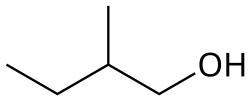
|
primary
|
2-Methylbutan-1-ol
|
128.7
|
3-methyl-1-butanol
or isoamyl alcohol
or isopentyl alcohol
|
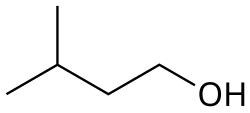
|
primary
|
3-Methylbutan-1-ol
|
131.2
|
2,2-dimethyl-1-propanol
or neopentyl alcohol
|
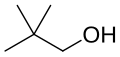
|
primary
|
2,2-Dimethylpropan-1-ol
|
113.1
|
2-pentanol
or sec-amyl alcohol
or methyl (n) propyl carbinol
|
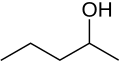
|
secondary
|
Pentan-2-ol
|
118.8
|
3-methyl-2-butanol
or sec-isoamyl alcohol
or methyl isopropyl carbinol
|
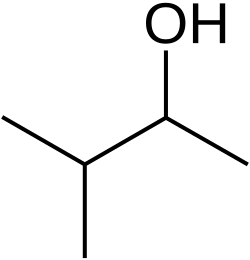
|
secondary
|
3-Methylbutan-2-ol
|
113.6
|
| 3-Pentanol
|
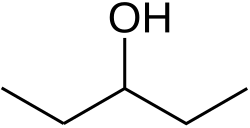
|
secondary
|
Pentan-3-ol
|
115.3
|
2-methyl-2-butanol
or tert-amyl alcohol
|
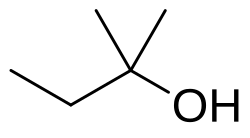
|
tertiary
|
2-Methylbutan-2-ol
|
102
|
Three of these alcohols, 2-methyl-1-butanol, 2-pentanol, and 3-methyl-2-butanol (methyl isopropyl carbinol), contain stereocenters, and are therefore chiral and optically active.
The most important amyl alcohol is isoamyl alcohol, the chief one generated by fermentation in the production of alcoholic beverages and a constituent of fusel oil. The other amyl alcohols may be obtained synthetically.
References
- ^ Merriam-Webster's Collegiate Dictionary 11th Ed. 2004
- ^ Falbe, Jürgen; Bahrmann, Helmut; Lipps, Wolfgang; Mayer, Dieter (2000). "Alcohols, Aliphatic". Ullmann's Encyclopedia of Industrial Chemistry. doi:10.1002/14356007.a01_279. ISBN 3527306730.
- ^ Calculated boiling points from ChemSpider.
Alcohols |
|---|
| By consumption | Alcohols found in
alcoholic drinks | |
|---|
| Medical alcohol | |
|---|
| Toxic alcohols | |
|---|
|
|---|
Primary
alcohols (1°) | | Methanol |
- 4-Methylcyclohexanemethanol
- Aminomethanol
- Cyclohexylmethanol
- Methoxymethanol
- Methylazoxymethanol
- Trifluoromethanol
|
|---|
| Ethanol | |
|---|
| Butanol | |
|---|
Straight-chain
saturated
C1 — C9 | |
|---|
Straight-chain
saturated
C10 — C19 | |
|---|
Straight-chain
saturated
C20 — C29 | |
|---|
Straight-chain
saturated
C30 — C39 |
- 1-Triacontanol (melissyl / myricyl)
- 1-Hentriacontanol
- 1-Dotriacontanol (lacceryl)
- 1-Tritriacontanol
- 1-Tetratriacontanol (geddyl)
- 1-Pentatriacontanol
- 1-Hexatriacontanol
- 1-Heptatriacontanol
- 1-Octatriacontanol
- 1-Nonatriacontanol
|
|---|
Straight-chain
saturated
C40 — C49 |
- 1-Tetracontanol
- 1-Hentetracontanol
- 1-Dotetracontanol
- 1-Tritetracontanol
- 1-Tetratetracontanol
- 1-Pentatetracontanol
- 1-Hexatetracontanol
- 1-Heptatetracontanol
- 1-Octatetracontanol
- 1-Nonatetracontanol
|
|---|
|
|---|
Secondary
alcohols (2°) | |
|---|
Tertiary
alcohols (3°) | |
|---|
| Hydric alcohols | |
|---|
| Amyl alcohols | |
|---|
| Aromatic alcohols | |
|---|
Saturated
fatty alcohols | |
|---|
Branched and
unsaturated
fatty alcohols | |
|---|
| Sugar alcohols | | C1 — C7 | |
|---|
Deoxy sugar
alcohols | |
|---|
Cyclic sugar
alcohols | |
|---|
| Glycylglycitols | |
|---|
|
|---|
| Terpene alcohols | Monoterpene
alcohols | |
|---|
Sesquiterpene
alcohols | |
|---|
Diterpene
alcohols | |
|---|
|
|---|
| Dialcohols | |
|---|
| Trialcohols | |
|---|
| Sterols | |
|---|
| Fluoroalcohols | |
|---|
| Preparations |
- Substitution of haloalkane
- Carbonyl reduction
- Ether cleavage
- Hydrolysis of epoxide
- Hydration of alkene
- Ziegler process
|
|---|
| Reactions |
- Deprotonation
- Protonation
- Alcohol oxidation
- Nucleophilic substitution
- Fischer–Speier esterification
- Williamson ether synthesis
- Elimination reaction
- Nucleophilic substitution of carbonyl group
- Friedel-Crafts alkylation
- Nucleophilic conjugate addition
- Transesterification
|
|---|
 Category Category
|
GABAA receptor positive modulators |
|---|
| Alcohols | |
|---|
| Barbiturates | |
|---|
| Benzodiazepines | |
|---|
| Carbamates |
- Carisbamate
- Carisoprodol
- Clocental
- Cyclarbamate
- Difebarbamate
- Emylcamate
- Ethinamate
- Febarbamate
- Felbamate
- Hexapropymate
- Hydroxyphenamate
- Lorbamate
- Mebutamate
- Meprobamate
- Nisobamate
- Pentabamate
- Phenprobamate
- Procymate
- Styramate
- Tetrabamate
- Tybamate
|
|---|
| Flavonoids | |
|---|
| Imidazoles |
- Etomidate
- Metomidate
- Methoxyetomidate
- Propoxate
- Isopropoxate
- Butomidate
- Iso-butomidate
- Sec-butomidate
- CF2-Etomidate
- CF3-Etomidate
- CF3-Propoxate
- Flutomidate
- 2,6-Dichloro-3-fluoroetomidate
|
|---|
| Kava constituents |
- 10-Methoxyyangonin
- 11-Methoxyyangonin
- 11-Hydroxyyangonin
- Desmethoxyyangonin
- 11-Methoxy-12-hydroxydehydrokavain
- 7,8-Dihydroyangonin
- Kavain
- 5-Hydroxykavain
- 5,6-Dihydroyangonin
- 7,8-Dihydrokavain
- 5,6,7,8-Tetrahydroyangonin
- 5,6-Dehydromethysticin
- Methysticin
- 7,8-Dihydromethysticin
- Yangonin
|
|---|
| Monoureides |
- Acecarbromal
- Apronal (apronalide)
- Bromisoval
- Carbromal
- Capuride
- Ectylurea
|
|---|
| Neuroactive steroids | |
|---|
| Nonbenzodiazepines |
- Imidazopyridines: Alpidem
- DS-1
- Necopidem
- Saripidem
- Zolpidem
- Pyrazolopyrimidines: Divaplon
- Fasiplon
- Indiplon
- Lorediplon
- Ocinaplon
- Panadiplon
- Taniplon
- Zaleplon
- Others: Adipiplon
- AXS-17 (BAER-101, AZD-7325)
- CGS-8216
- CGS-9896
- CGS-13767
- CGS-20625
- CL-218,872
- CP-615,003
- CTP-354
- ELB-139
- GBLD-345
- Imepitoin
- JM-1232
- L-838,417
- Lirequinil (Ro41-3696)
- Miltirone (rosmariquinone)
- NS-2664
- NS-2710
- NS-11394
- Pipequaline
- ROD-188
- RWJ-51204
- SB-205,384
- SX-3228
- TGSC01AA
- TP-003
- TPA-023
- TP-13
- U-89843A
- U-90042
- Viqualine
- Y-23684
|
|---|
| Phenols | |
|---|
| Piperidinediones | |
|---|
| Pyrazolopyridines |
- Cartazolate
- Etazolate
- ICI-190,622
- Tracazolate
|
|---|
| Quinazolinones |
- Afloqualone
- Cloroqualone
- Diproqualone
- Etaqualone
- Mebroqualone
- Mecloqualone
- Methaqualone
- Methylmethaqualone
- Nitromethaqualone
- SL-164
|
|---|
| Volatiles/gases | |
|---|
| Others/unsorted |
- 3-Hydroxybutanal
- α-EMTBL
- AA-29504
- Alogabat
- Avermectins (e.g., ivermectin)
- Bromide compounds (e.g., lithium bromide, potassium bromide, sodium bromide)
- Carbamazepine
- Chloralose
- Chlormezanone
- Clomethiazole
- Darigabat
- DEABL
- Deuterated etifoxine
- Dihydroergolines (e.g., dihydroergocryptine, dihydroergosine, dihydroergotamine, ergoloid (dihydroergotoxine))
- DS2
- Efavirenz
- Etazepine
- Etifoxine
- Fenamates (e.g., flufenamic acid, mefenamic acid, niflumic acid, tolfenamic acid)
- Fluoxetine
- Flupirtine
- Hopantenic acid
- KRM-II-81
- Lanthanum
- Lavender oil
- Lignans (e.g., 4-O-methylhonokiol, honokiol, magnolol, obovatol)
- Loreclezole
- Menthyl isovalerate (validolum)
- Monastrol
- Nicotinic acid
- Nicotinamide
- Org 25,435
- Phenytoin
- Propanidid
- Retigabine (ezogabine)
- Safranal
- Seproxetine
- Stiripentol
- Sulfonylalkanes (e.g., sulfonmethane (sulfonal), tetronal, trional)
- Terpenoids (e.g., borneol)
- Topiramate
- Valerian constituents (e.g., isovaleric acid, isovaleramide, valerenic acid, valerenol)
- Unsorted benzodiazepine site positive modulators: α-Pinene
- MRK-409 (MK-0343)
- TCS-1105
- TCS-1205
|
|---|
See also: Receptor/signaling modulators • GABA receptor modulators • GABA metabolism/transport modulators |
| Authority control databases | |
|---|